
City - on the bus. Do the bloody homework!
A 2-1 loss in what felt like our biggest game in over six years. It could have been so different, though.

Arteta’s starting line-up was, on the whole, pretty solid (Eze at left wing, Odegaard at 10, Havertz at 9). The only genuine question mark was Madueke on the right. He has been rather ineffective recently in attack. Even his adventurous, albeit purposeless, runs which previously took a toll on defenders seem to have stayed in the first half of the season. Critically, he is not a defensive engine, and the goal conceded against Bournemouth last weekend confirmed this statement. I would have much preferred Martinelli if the goal was to track O’Reilly, or Max Dowman, if we wished to take the bull by the horns and try to accommodate his defensive flaws.
The first half proved my point. Madueke was simply not mentally up for a match of this caliber and responsibility. He tracked back a couple of times, yes, but in the final third, he completely failed to get his act together. To be fair, the opening minutes were nervy from both sides. Raya miscontrolled a simple back pass, Haaland pounced like a hawk, and we were mere centimeters away from falling apart like a house of cards. This mistake really riled up the City crowd, pushing their team right into our box, where a deflection off Gabriel saw the ball hit the post and luckily bounce back out.
Slowly, we did manage to claw back some control. In fact, we pressed them well and won the ball back high up the pitch three or four times. City were also highly nervous, but we failed to capitalize because every time a player found themselves near their box, they entirely lacked composure. Eze’s pass put Havertz clean through (into a potentially offside position), but Kai’s control was as poor as Raya’s—just kicking the ball a meter ahead for no good reason.
The only player who showed any measure of composure on the ball was Eberechi Eze. Our number 10 was typically calm, perhaps too calm, but capable of turning with the ball, dribbling past City players, and generally being in full control of his feet. The problem was that Eze was deployed on the left wing, limiting his ability to influence our whole build-up. Odegaard, despite a decent showing for someone returning from injury, was simply not at the required fitness level to properly run the show.
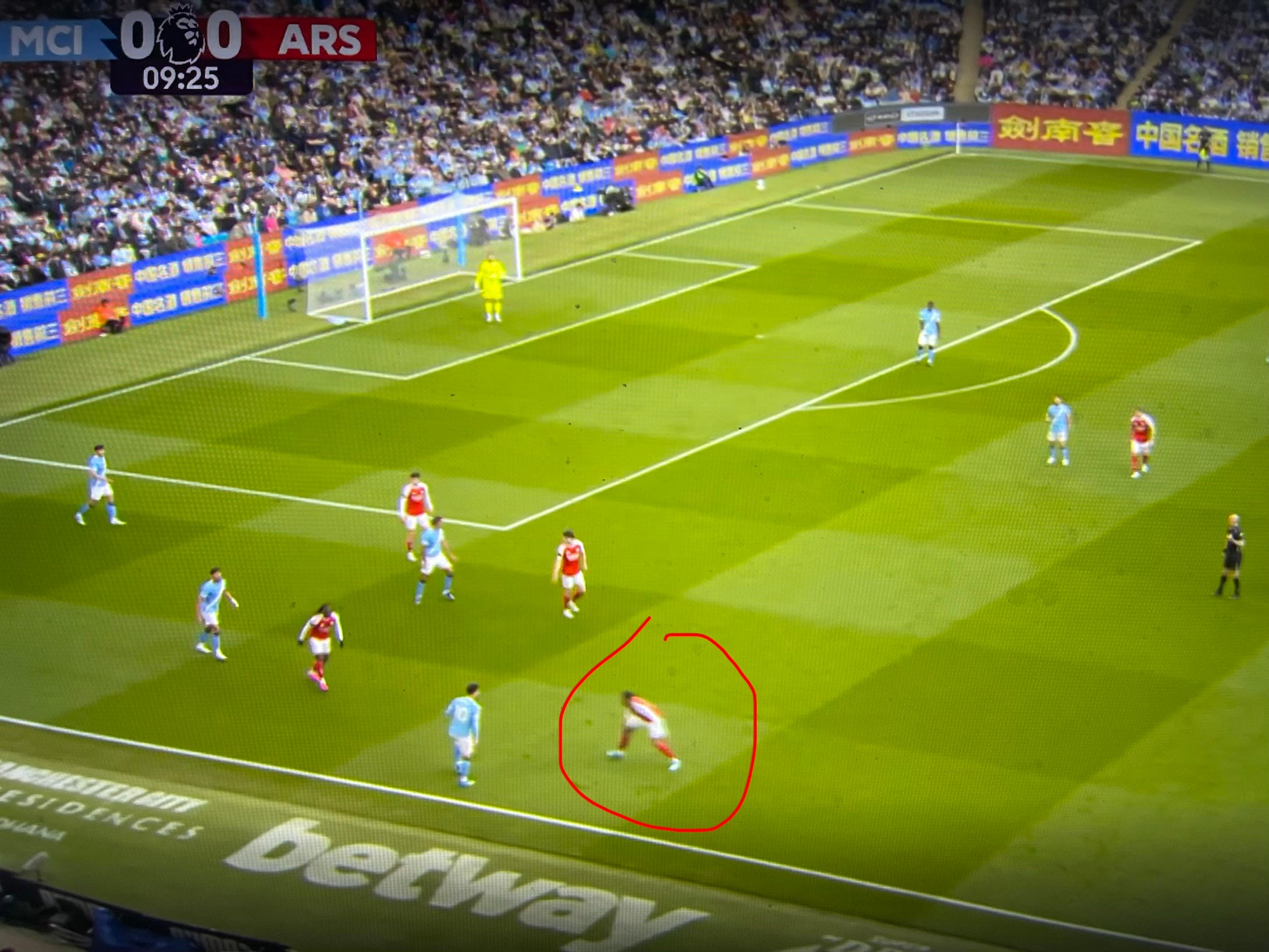
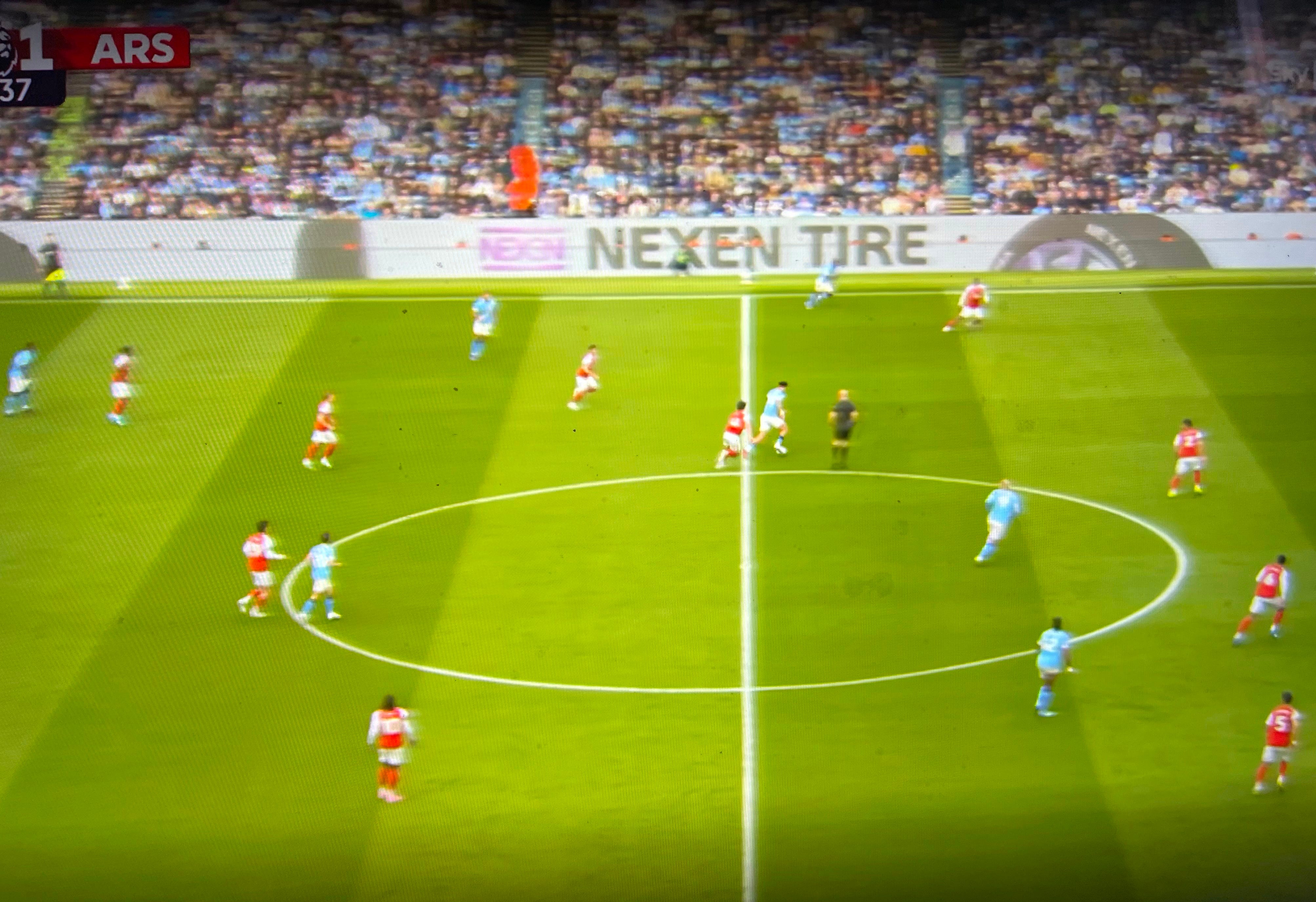
Guardiola had prepared several solutions to unlock our defense. One involved Cherki, who was practically moving freely across the pitch, creating overloads in different areas for which we had no proper answer. Apparently, Gabriel was tasked with tracking him, and at times he ended up far too high up the pitch when attempting to stop Cherki from turning with the ball, as seen in the image below. (I apologise for the quality of the screenshots in this post, but quality images are hard to come by on short notice).
At other times, no one was tracking his runs at all. I thought this would fall to someone in the number 6 zone like Rice, since anyone who follows City a bit and watched the Carabao Cup final knows that Cherki is their most dangerous player. Semenyo has been out of form lately, and Doku is not exactly a model of consistency. But Cherki has the ability, and more importantly, the arrogance, to simply run at any defense. The first warning shot came on the 15th minute, when Cherki received the ball unchallenged outside the box and dribbled his way into it before hitting the ball straight into Saliba’s leg.
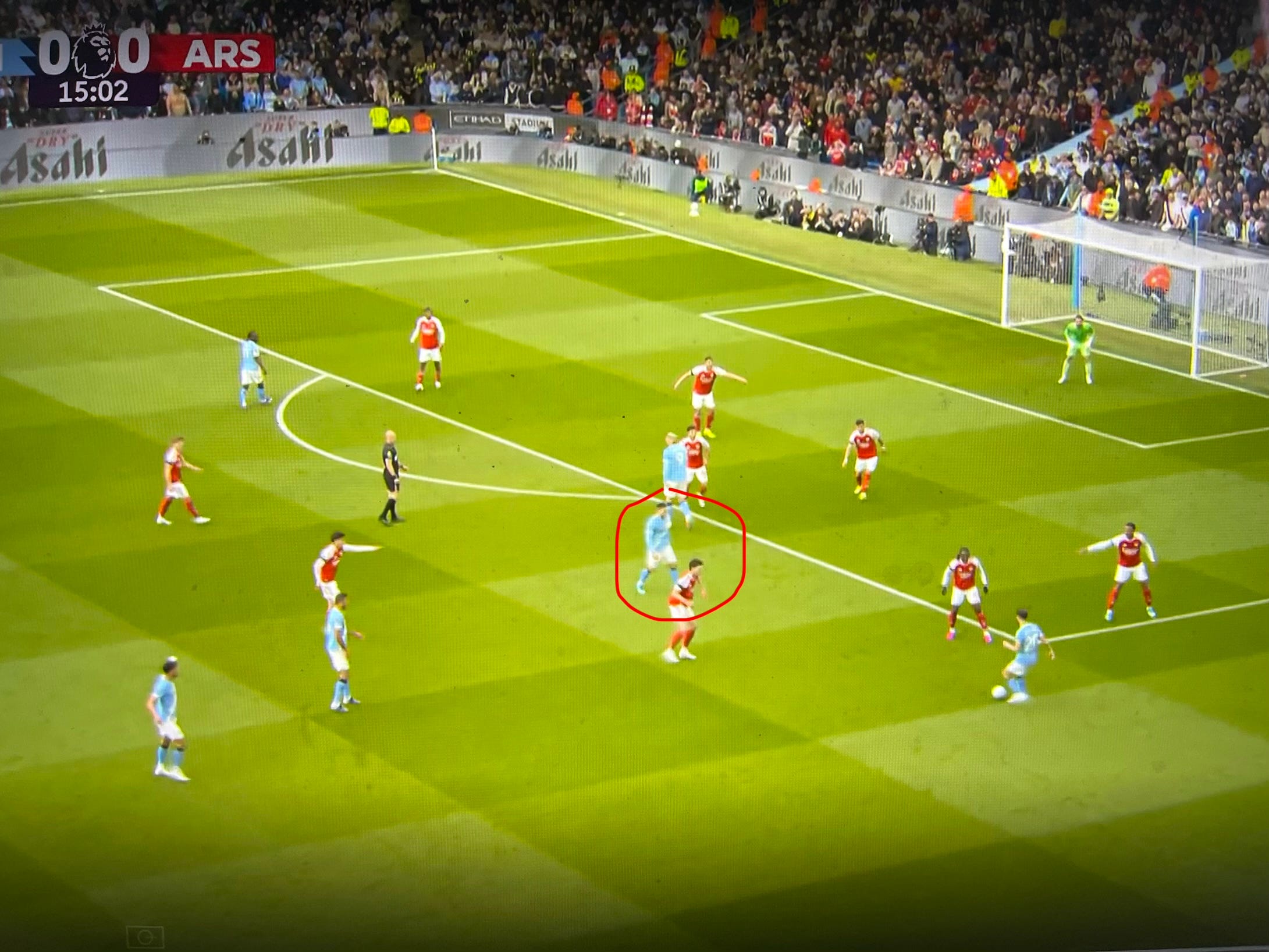
And, as is the way of football, in the second identical attempt, he dribbled his way from the exact same starting position right into our bottom right corner. 0-1, again inside the first 20 minutes at the Etihad. How on earth did we allow him several times to receive the ball facing the goal and have a run at us? Shouldn’t there have been an instruction to track him at all times and deny him the chance to start his run? How could the manager, who is supposedly super attentive to every little detail, let this happen? We have a physically dominant midfield that should enforce that physicality before allowing technically gifted players to have their way. The most frustrating part of all was that this wasn’t even his first try.
Cherki’s goal again clearly demonstrated our real lack of players who can take matters into their own hands in the final third. We had thought Saka would be that player for us, but he stopped being that after the hamstring surgery. The only one who has demonstrated this ability in recent weeks was Eze. I know many were angry at him for avoiding the challenge for the ball that led to Cherki’s goal. I don’t think he was in a position to win that challenge though This was probably a reflex from his Palace days and he can definitely improve there, but I don’t believe his action was decisive in the goal.
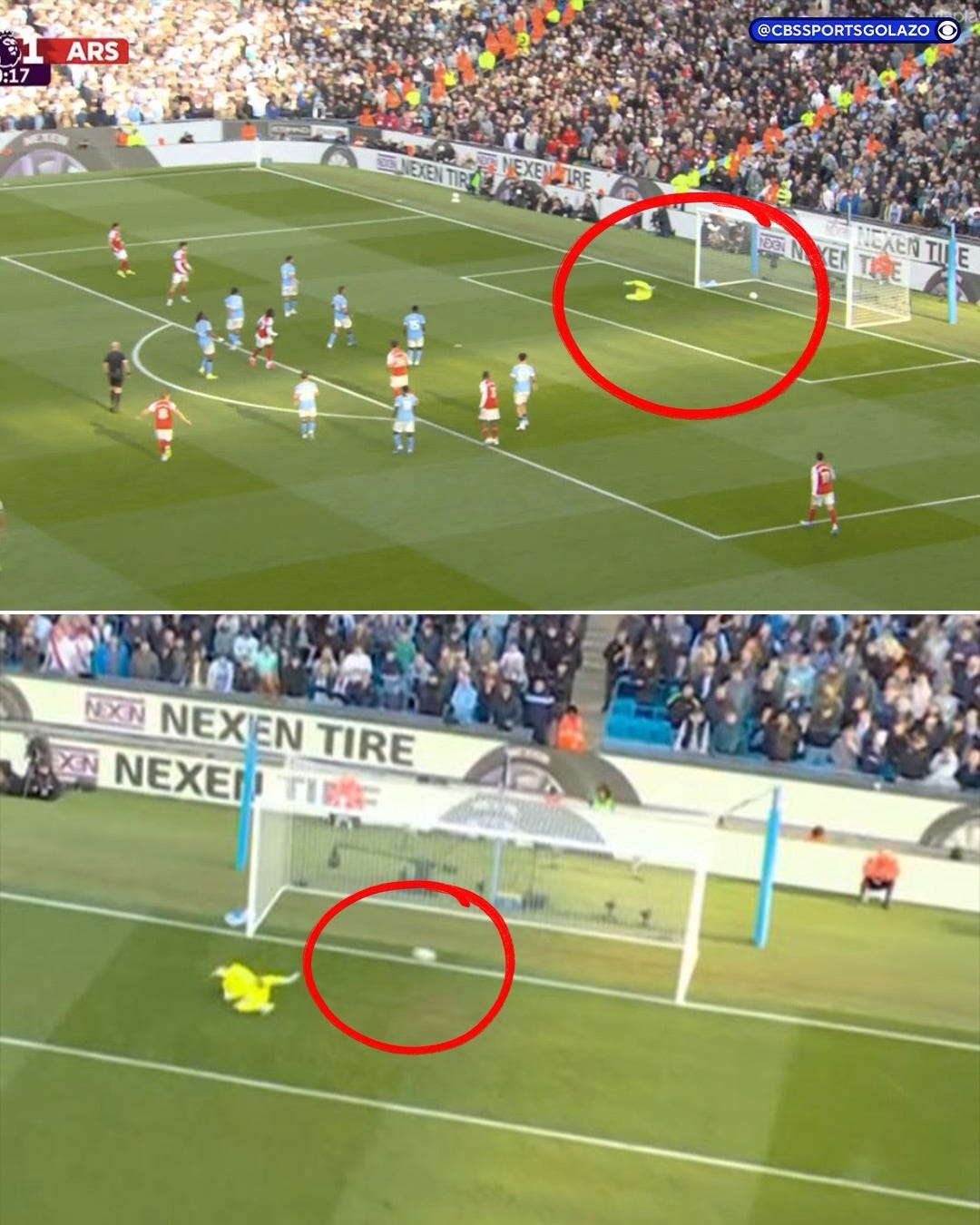
It was a proper kick in the nuts, but only a minute later Donnarumma returned the favour to City’s fans by failing to handle the ball under pressure from Havertz. The German blocked his kick-away, and the ball headed straight into the net. We were somewhat lucky, because even a blocked ball could easily have gone wide of the goal.
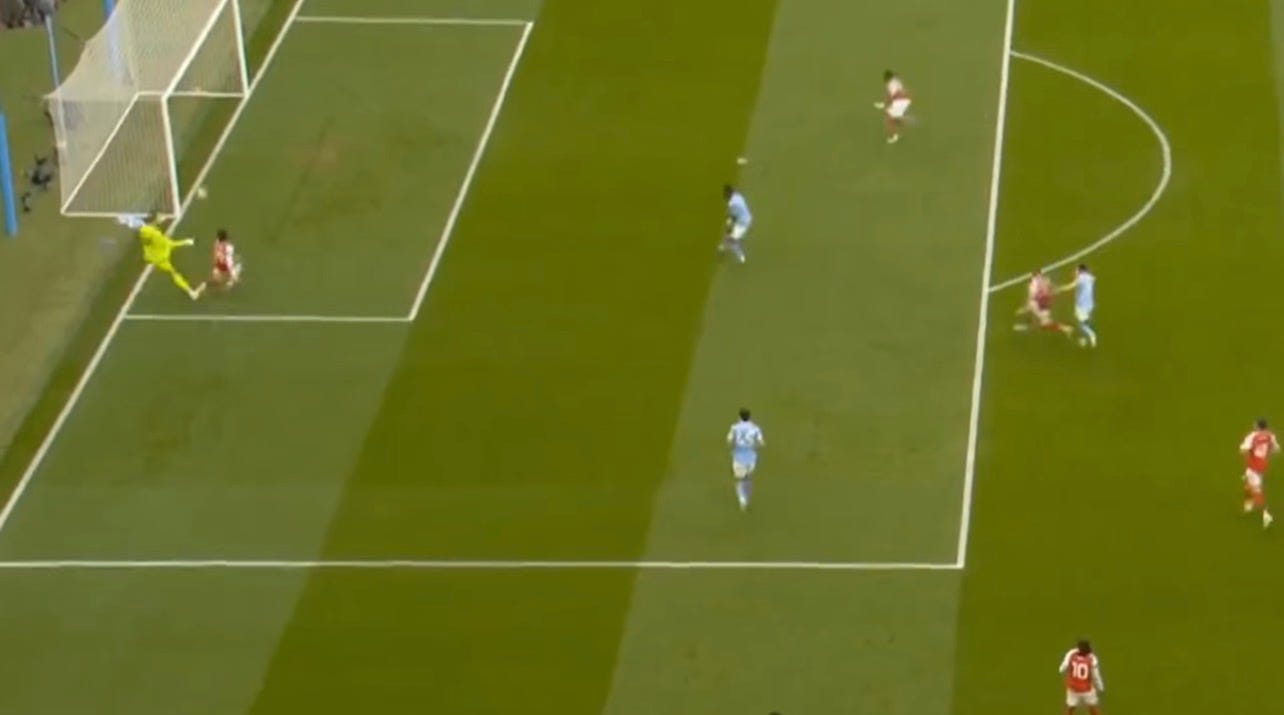
The biggest benefit of this goal was exposing City’s nerves and their vulnerabilities. Instead of letting ourselves dwell on the inevitability of the Etihad defeat, this moment gave a real boost of belief to everyone. The game did calm down afterwards, but City kept asking us questions.
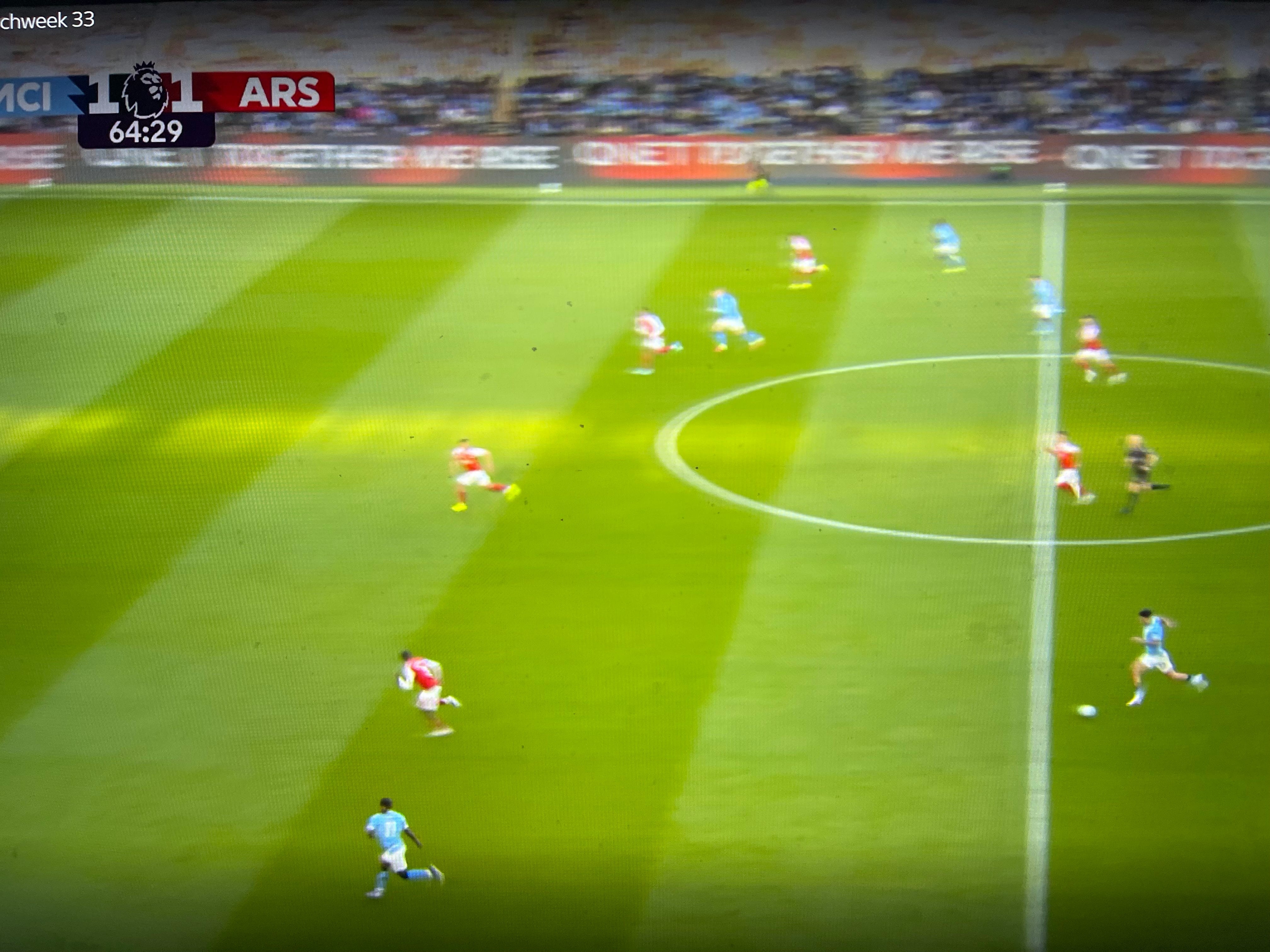
Guardiola’s second piece of preparation was designed to pull our defense out of shape: Haaland would vacate his centre-forward position to drop deep and receive the ball, while another player (Bernardo Silva in the image below) would make a run to attack our defenders at full speed.
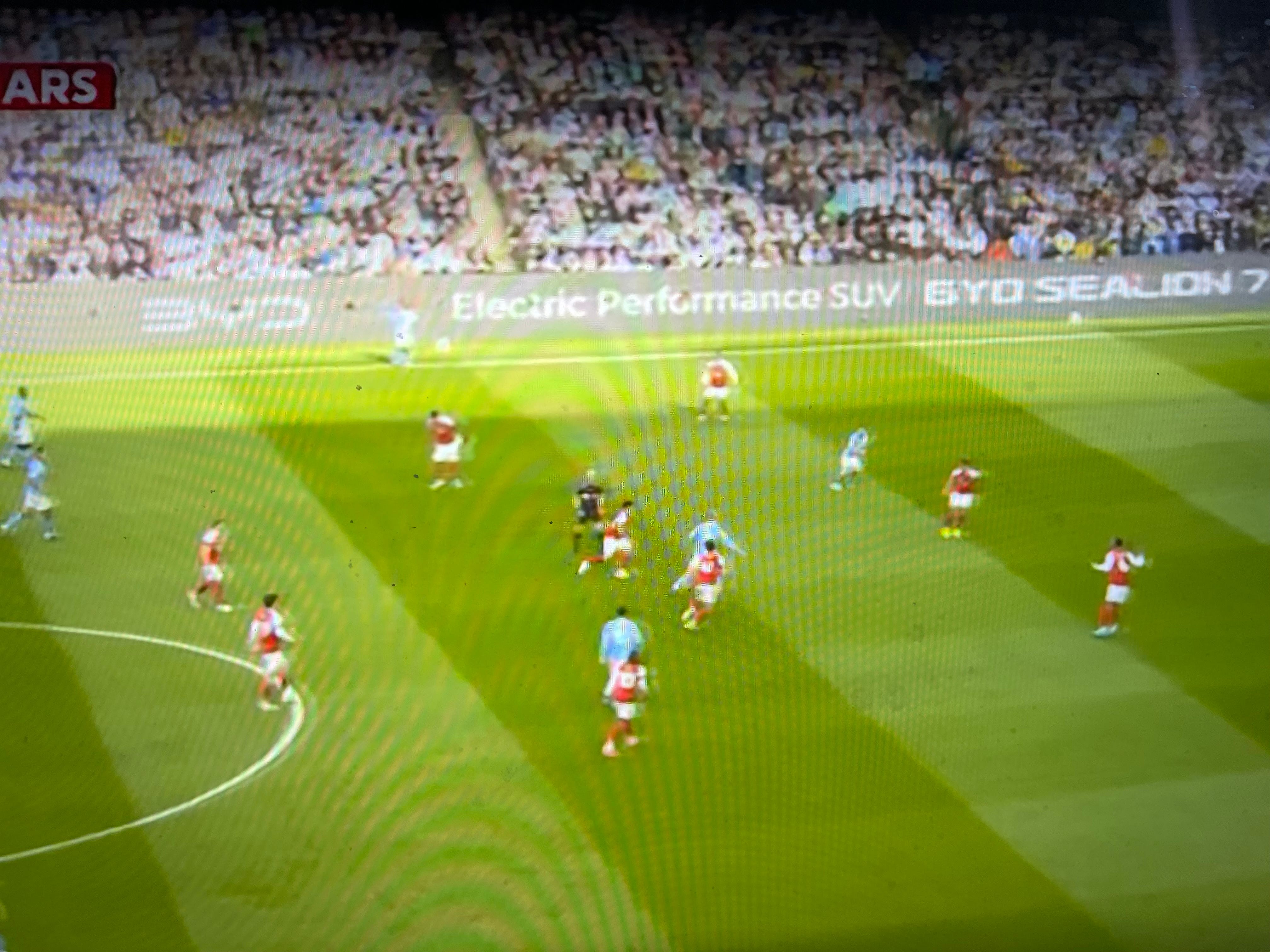
This is not an easy situation for a centre-back to handle, because if you leave your position and fail to block Haaland’s pass, you give the opponent a high way to goal. If you don’t, you risk being overloaded by both players. Rice managed to drop back and block the shot, but it was clear that Guardiola had done his homework. He prepared multiple ways to pull us out of shape.
What frustrates me as an Arsenal fan is that we never arrive to play against big teams with this type of movement, with any real attempt to trouble their defenders by dragging them out of their comfort zone. Every Arsenal player is so tied to their positions and functions. Wingers receive the ball close to the touchline, and Odegaard never makes those ‘second tempo’ runs into the box. Whenever Havertz drags a player with him, a teammate is rarely prepared to fill the newly created void.
We were supposed to see how Arsenal would respond to the successful 4-2-4 press that has been so effective for our opponents recently, starting with City. Predictably, Rice and Zubimendi offered little help in this regard, but dropping Odegaard deep and moving Eze offered two new options to beat the press. The problem is that even with these two options, we still didn’t play through the centre.
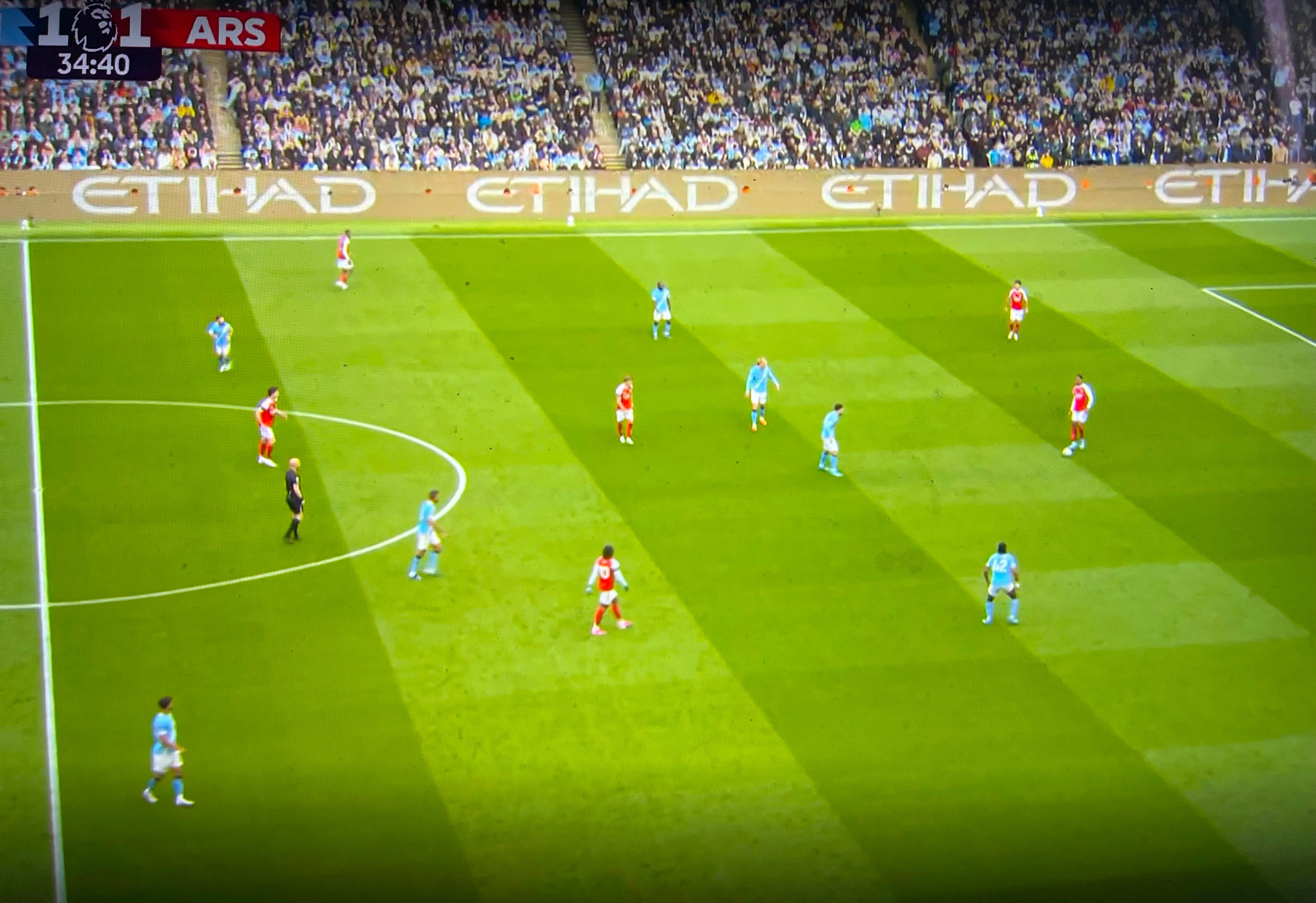
In the first situation, Eze is clearly open and Odegaard is positioned well to support the attack, yet Gabriel sends the ball sideways to Zubimendi.
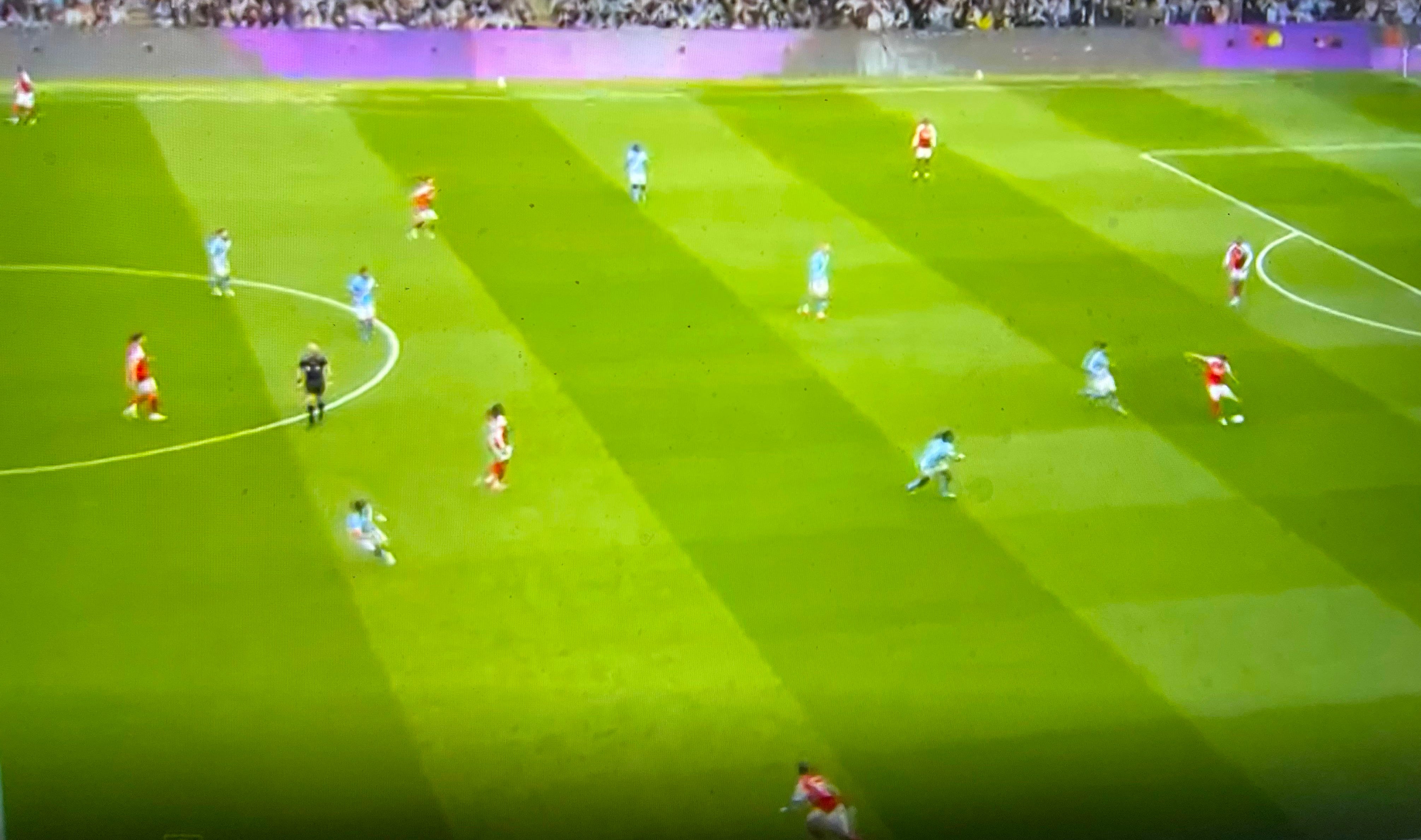
In the second situation, Odegaard drops really deep to receive the ball, and instead of finding Eze with a vertical pass—giving him multiple options to continue the attack—he plays it sideways to Hincapie, a player not exactly known for his security under pressure. Hincapie put in an amazing defensive shift and joined our attacks throughout the whole match, and I have absolutely no complaints about him, but he’s not a technically secure player. He doesn’t have the feet to bypass the man-to-man press; he needs to be released into space to run.
The third thing that worked for Guardiola was Nico O’Reilly. First, he managed to get out with the ball in a situation like this.
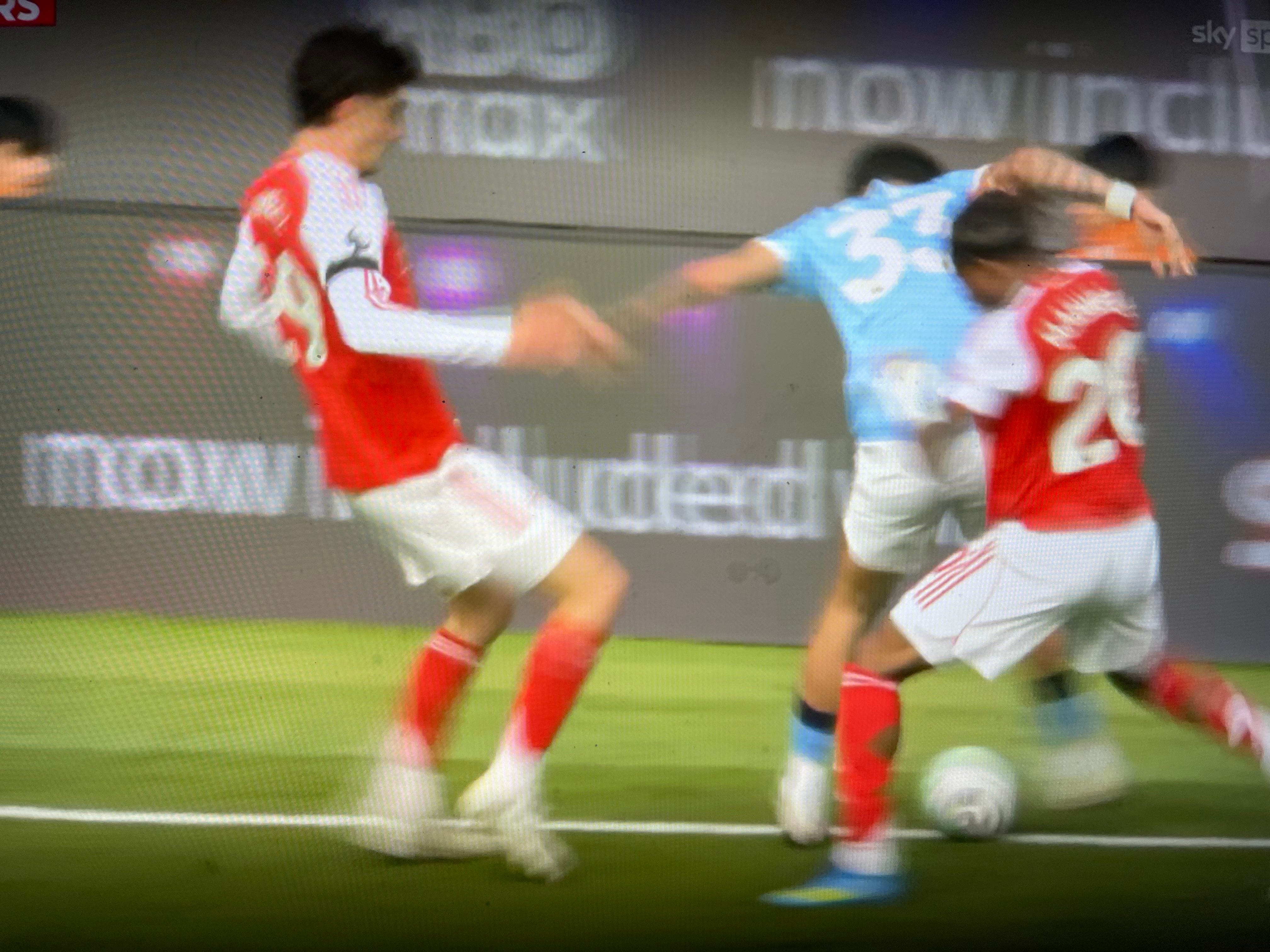
Second, his constant runs from left-back into the left-eight zone were not even the slightest bit of surprise. Let’s be honest, after he practically decided the Carabao final in City’s favour, even Dowman’s nun knew he was going to bring a threat from that left-back position. And somehow, SOMEHOW, Arsenal was not fully prepared for it. In the first half, O’Reilly created a chance from this position.
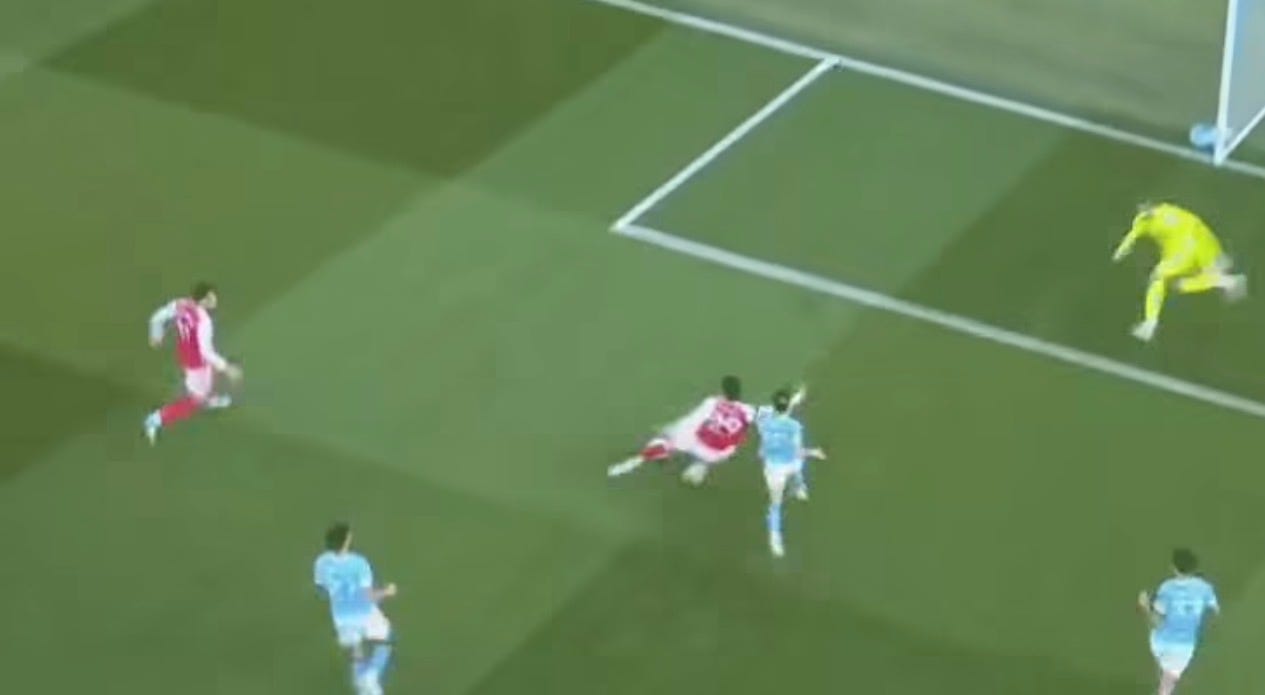
And in the second, his run was decisive for the winning goal. He was completely alone in the middle of the pitch, and after passing the ball to Doku, he was again dropped in the box by Zubimendi (another decisive mistake in a overall subpar performance from the number 36) , from where he created the winning assist.
How could we be so unprepared to deal with the runs of the player who scored twice in the Carabao final? How could Arteta not have stressed this to every player on the right-hand side? How could he fail to give exact instructions on how to behave in each situation?
Martinelli replaced the non-productive Madueke at half-time, which was the right call, but somehow the team wasn’t properly instructed. I don’t know whether it was Zubimendi’s responsibility to close down O’Reilly (I suspect it was in this situation) or if Mosquera should have passed Doku over to Saliba and moved up, but the move was not executed. I wouldn’t believe for a single minute that Martinelli, if strictly instructed to track O’Reilly, would make a ‘head-off’ run forward. This was so damn frustrating, because it was so damn predictable. A clip on social media showed Odegaard pointing out O’Reilly moments before he received the ball, which was fantastic situational awareness from the captain, but it resulted in precisely zero action.
O’Reilly was again City’s Player of the Match and he practically dominated us completely. He didn’t give a sniff to any of our right wingers, and he was crucial to City’s attack and the winning goal. How could their young talent have such a strong outing, while half of our attacking players can’t properly compose themselves?
I saw the opinion that Gabriel should have blocked Haaland, but as you’ve witnessed in this match, in a high-calibre game, strikers will get their couple of chances. The question is whether they’ll take them. Haaland took his chance, while Havertz did not. In the middle of the second half, well before City’s second goal, after an interception in the middle of the pitch, we had a 4-v-3 counter-attack that was executed almost perfectly. Havertz received a superb chance to virtually bury City’s hopes of a win, and he failed to convert it.
This was a big moment in a big game—the kind that separates winners from runners-up, the best players from the very good ones, the ones that come down in history and are rewatched for years to come—and Havertz didn’t take it. This chance reminded every Arsenal fan exactly why we were begging for a striker for the last two seasons and searching for one last summer. Now we have Gyokeres, and we are in a situation where one of our strikers is a great finisher but lacks all the skills needed to get into a shooting position, while the other is great at link-up play and getting into dangerous positions, but he can’t keep his composure under pressure.
Also, how come Havertz always end up falling when he needs to shoot and the result is on the line?
The situation did not require falling on the ground at all, and I wouldn’t imagine the best strikers ending up there, but somehow Havertz is always on his way to the grass. He fell when attempting to score a rebound after Gabriel’s header hit the post. He fell to the ground after a push from Khusanov before he could run 1-on-1.
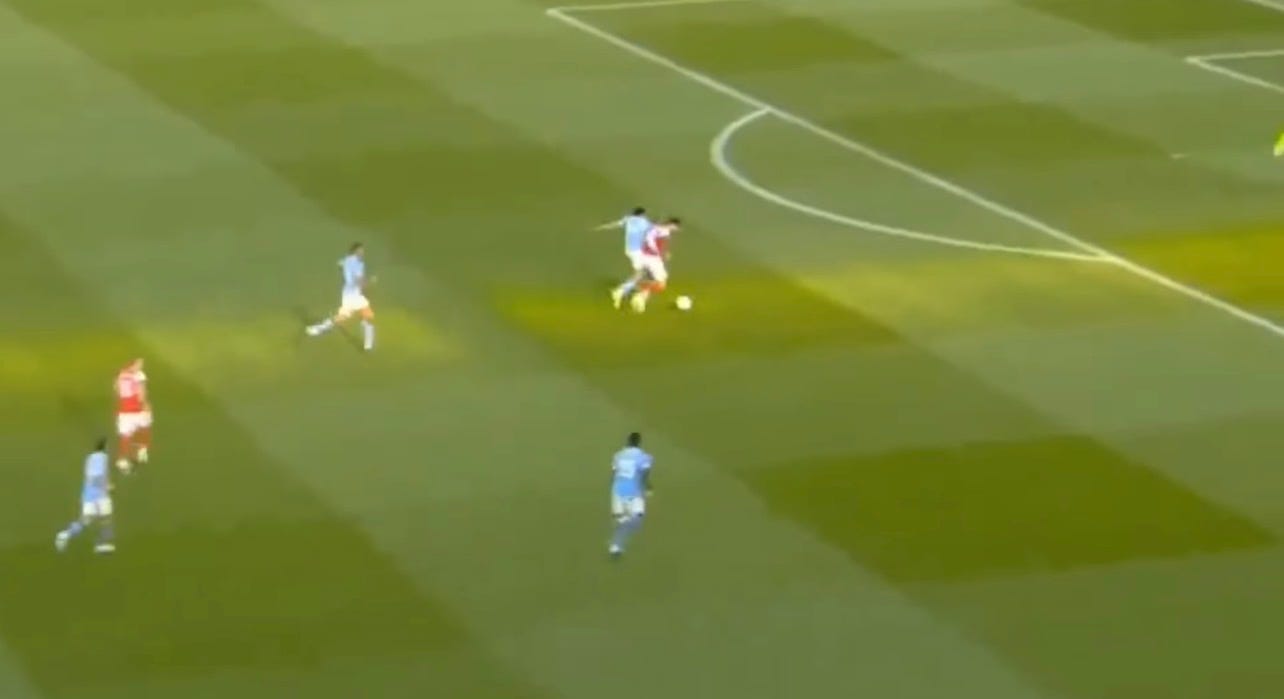
I think this could easily be blown as a foul in some circumstances, because Khusanov is not playing the ball, merely the man, and he’s clearly behind Kai. That said, somehow Havertz, despite his ability to win headers and shield the ball, always looks so unstable on his feet when running with it. And this impression of players being so unstable on their feet gives referees grounds to ignore these situations and not call for a foul.
Around the 78th minute, we had a massive opportunity for a 2-on-1 attack, but somehow Havertz failed to keep Bernardo Silva away from the ball. Despite being in front of him, despite practically holding Bernardo under the armpit like a hobbit, Havertz couldn’t shield him away. Just put your body between himself and the ball and be done! Either continue running or earn a red card for the opponent! It is immensely frustrating to see a number nine with such clear limitations.
We had another chance, however, to take an early lead when Eze, surrounded by two City defenders, turned around and sent a ball into the top-left corner with his left foot. This time City were truly lucky the ball didn’t find the net. This was our only chance of the game created entirely out of nothing.
What were Arteta’s actions following that? He took off Eze for Trossard after the City goal. How could you take off your most composed player in front of goal? How could you take off the only player who could turn around and dribble past two City players in the middle of the pitch? How could you take him off and leave Odegaard, who had clear fitness concerns, on the pitch? I had no problems with Odegaard’s performance by the way, but it was crystal clear that he couldn’t run up-and-down for 90 minutes.
And even if you wanted to keep Odegaard for his leadership, ball control, and positional awareness, there was a simple solution: take Zubimendi off, move Odegaard deeper (where he was most of the time anyway), and push Eze into the middle, closer to the box, from where he could threaten more often. It was so logical, and the most frustrating part was that Arteta later took Zubimendi off for Gyokeres, who was practically useless.
The only reason I can think of for Eze’s removal is his defensive flaws, but that was another confirmation of Arteta’s priorities when it comes to player purchasing and selection. No matter your creative output, the key is maintaining out-of-possession shape. How can a coach be thinking about defensive issues when we are losing 2-1? Why would he not leave his most dangerous players on the pitch? What else did we have to lose at that point?
Do you honestly think Salah was tracking back much and winning duels in 24/25? Hell no, but Slot kept him on the pitch because he was constantly scoring goals, and goals win you games and points. Moreover, Slot adjusted the defensive formation to ensure Mo stayed as far up the pitch as possible. How did Arteta accommodate Eze’s explosiveness? I didn’t notice any accommodation, but what I did notice was clear anger at his defensive mistakes.
And then we wonder why Arteta buys players who can’t consistently deliver goals or attacking threats in teh business end of the season? It’s because he doesn’t value this quality as much as he values the out-of-possession shape, winning duels, and tracking back. He would never sign someone like Cherki for that exact reason.
That substitution was the moment I lost belief we could equalise. You know why? Because none of our players have the mentality, calmness, and composure to decide a BIG game in a BIG moment. And to prove that statement, in injury time Havertz managed to send an open header wide after a beautifully carved out cross by Trossard. Head it down into any part of the goal and Donnarumma would have been helpless!
Another great chance missed, as well as the opportunity to make a statement in the title race. The most disappointing aspect of this game was that City were far from invincible. They didn’t have many successful ideas; they certainly didn’t have the Rodri and De Bruyne of old capable of totally running the midfield and the game.
We were nervous, but we didn’t crumble into pieces. There were periods in each half where they were the more aggressive team, creating more chances. Crucially, we created enough to come away with one or all three points. Our defenders put in a good shift, including Mosquera and White, who I think really stood up to the occasion.
But we lost because Arteta didn’t do his homework fully when it came to preparing for City.
The team gave Cherki, their most creative player, too much space and time, and we paid for it with the first conceded goal.
There was no constant solution to block O’Reilly’s runs, which were well known before the game, and we paid for it with the second conceded goal.
Arteta failed to recognise who was the most dangerous player in front of goal in a big moment, took Eze off the pitch, and we paid for it by failing to find a late equaliser.
These were three simple mistakes that could have easily been avoided. And the main person responsible for that is the manager, Mikel Arteta.
This was one of our stronger performances at the Etihad, but it still ended in defeat at a crucial moment, and now we are basically on the same number of points as City.
The title race is not over yet, because both teams can still lose points in the remaining games, as neither side is perfect. Even if they don’t lose, it will come down to goal difference, which is something we still control.
However, the problem is:
Momentum is now clearly with City—they will reduce the nine-point gap to zero in midweek when they play Burnley.
We are not currently a high-scoring team, so counting on a better goal difference is truly naive. Especially when we play teams like Newcastle, Fulham, or West Ham, who won’t just throw games away to us.
Despite the common belief that City’s calendar is harder, they don’t actually play any team with something major on the line. They don’t play any teams fighting for relegation; most of their opponents are confident mid-table sides, and Aston Villa have probably already guaranteed their Champions League spot with Chelsea being nine points behind. Whereas we actually play West Ham away, who are in a true dogfight with Spurs.
Therefore, the reality is that City, at this point, simply have higher chances. And it doesn’t matter that we played decently today, because we entered a “no-excuse zone” after we properly botched our position last Saturday at home against Bournemouth. Even a single point against the Cherries would have left us in the driver’s seat. That loss made today’s game a heroic “Do or Die” situation, and we failed to “Do it”. Arteta’s team failed to “Do it” once again, and at this moment it doesn’t matter why. At some point, a pattern must be recognised as a pattern and not just a series of explanations. And when a pattern is detected, it should be addressed with the necessary measures.
I am not throwing a towel on the season, but every such result shatters the belief Arteta’s Arsenal can deliver in critical moments. We wasted another chance to take the matter in our own hands, to slay the demons to elevate the mentality of this club into another level. And there won’t be many more chances left in this Arsenal iteration.
I’m typically pro Arteta but I’m in lockstep with you on this one. Mikel missed opportunities to prep the team for success against City given what we have seen and know of them this season.
Still to play for but it shouldn’t have come to this. Gonna take something Herculean to pull off the title now, but hey 5 games to go. Let’s see what happens.