
Southampton - on the bus. Testing the floor
Two trophy chances gone up in smoke in as many matches for Arsenal.

Arteta went with a XI appropriate for the occasion. It’s pure naivety to think a squad can scrap with their best line-up on three fronts and come out on top in every single one. You’ve got to have priorities, and for us, the focus has to be the silverware we actually have the best shout at winning.
I was delighted to see Arteta take this approach. Of those recent injury scares who pulled out of the internationals, only Gabriel made the pitch. The bench was packed with youngsters too, a proper shift from the previous rounds. Kepa got the nod in goal again, confirming that cup runs were the carrot dangled by Arteta when he signed. That’s likely his last run-out of the season, and I can’t say I’m gutted. Max started on the right, immediately becoming the focal point for Arsenal fans and opposition defenders alike.
On paper, the starting side looked a decent blend—strong enough to handle Championship opposition without overplaying the regulars. From the off, the pattern was clear: we dominated the ball, constantly probing their box. They looked to hit us on the break, mostly through their number 13, Leo Scienza, who was a right thorn in the arse of our backline all evening.
The attack—featuring a returning Ødegaard, Havertz, Dowman, Martinelli, Myles, and White—looked sharp. Most of the joy came down the right, with Dowman carrying the ball and Ødegaard pulling the strings. It felt like a goal was only a matter of time in that first half.
But it turned into a half of “nearly” moments. Dowman nearly threaded it through a forest of legs, Martinelli nearly burst the net only to see a defender’s head in the way, and Havertz nearly buried a header. Ødegaard nearly marked his return with a massive confidence booster.
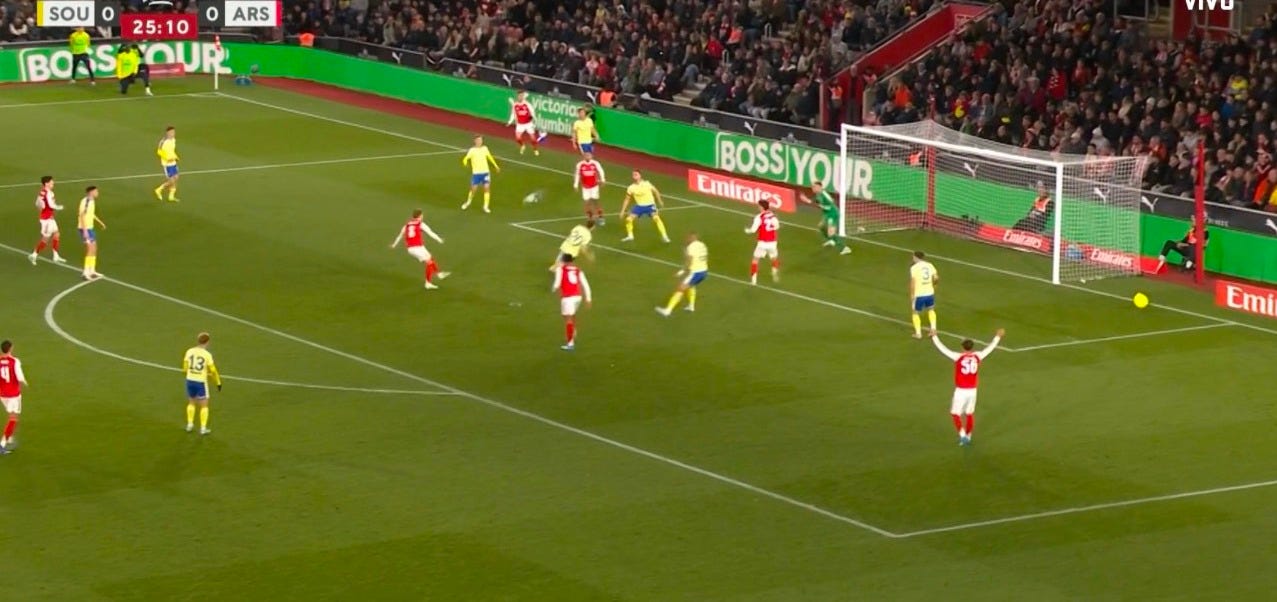
This was a type of situation our team found itself multiple times in the first half. It’s not about picking on Ødegaard—no one took their chances—but it highlights the quality of openings we wasted. Martinelli, Dowman, and Ødegaard were all inches away. You know who wasn’t even close? Gabriel Jesus. Honestly, it was embarrassing. The lad is putting in testimonial-level performances on 250k a week; I don’t want to see him near the grass for the rest of the season. Gyökeres and Havertz are our strikers now. Martinelli, Madueke, and Dowman are our attacking options to change the game from the bench.
Southampton weren’t just making up the numbers, though. Scienza was constantly asking questions of our defenders. He even rounded Kepa once, but Mosquera was there to put out the fire. This time.
Predictably, after we botched our chances, they took theirs. A cross from the left, a rare poor bit of defending from White, and a simple finish for the Saints winger. That sort of half-hearted jump—a schoolboy error, really—from White, from a usually disciplined Arteta defence showed the mentality and concentration were miles off the pace on the day.
White was poor, Lewis-Skelly got caught in possession a few times, and Mosquera had a couple of wobbles. Christian is a strange one; he seems to have a mistake in him regardless of the opponent. We were buzzing when he only made a couple of errors at Anfield, but who expected that same number of mistakes against Mansfield and Southampton? Perhaps that’s just the tax you pay for playing youth. Mosquera is nearly 22—hardly a kid by Arsenal standards, but still green for a centre-half in the grand scheme of things.
That said, concentration is non-negotiable for a defender. A winger can go goofing around for half an hour, then pop up with a couple of runs and a goal to be the hero. But for a defender or a keeper, if you switch off for a couple of moments, the game can be gone. Being “on it” for 90 minutes is the most vital skill they need to hammer home.
The game was not over for us, we were only a goal down, but the way the match was going didn’t fill me with hope. The second half was a carbon copy: plenty of huff and puff, especially from Dowman, but zero end product. No converting the individual supremacy, no cold blood in front of goal, no pulling the trigger —no Eberechi Eze. It made me realise what Eze brings to the table. “A man of few chances”, despite having fluctuations in his form, was always making his mark against lower league sides. That’s what sets him apart.
Arteta had to roll the dice, bringing on Madueke, Gyökeres, and Calafiori, especially after Myles coughed up the ball again in midfield. With fitness in mind, Ødegaard was hooked, effectively leaving the keys to our attack in the hands of a 16-year-old for the business end of the game.
Individually, Dowman was superb all game. He was our best outlet for carrying the ball forward, fearless and really calm under pressure. But he wasn’t on the same wavelength as the rest of the attack. It makes sense—he hasn’t had enough minutes with the seniors to understand their patterns. He lacks the experience to read the game in real-time and make the right call, which was glaringly obvious when he botched a simple pass to Gyökeres in a 3-on-3. The ball was both mistimed and misplaced.
The real worry isn’t how to get more out of a schoolboy, though. It’s why our senior attackers lack the bottle to take players on and create their own chances. We did scramble an equaliser though. Havertz made a clever run, Gabriel (of all teammates!) found him with a through ball, that caused chaos in the box, and Gyökeres pounced.
Whatever criticism I gave Viktor, his engine and determination are top-drawer, and that usually pays dividends against weaker backlines. We had the momentum with one more goal to go, Arteta then swapped Havertz for Zubimendi, clearly with an eye on other competitions (a move I still stand by).
Unfortunately, it was more of the same. When Southampton bagged the winner in the 84th minute, I wasn’t even surprised. They were well up for it, their fans were roaring them on through every tackle, long ball and keeper’s save. They threw bodies on the line. Their left-back was clearly out of his depth against Dowman but did everything humanly possible to stop him, even risking a red.
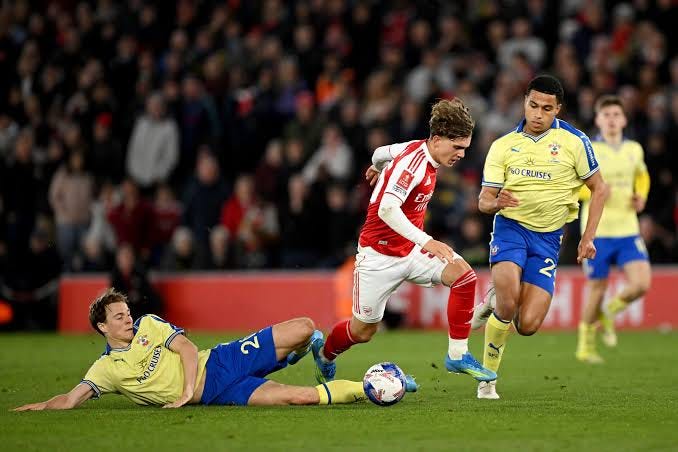
The ref could easily have sent one of them off for some industrial challenges, but we can’t hide behind officiating for this defeat.
Processing the defeat
The City game was a test of our ceiling—a ceiling we feared wasn’t high enough given our record against the big six this year (Liverpool, Man United, Man City). This match, however, was a test of our floor. That floor has been high all season; The floor that got us to the top of the Champions League group stage, to first place in the League and into the Carabao Cup final.
That high floor comes down to two things. First, we spent a wedge in the summer. We brought in Madueke, Hincapié, Nørgaard, Kepa—the players with proper first-team minutes from serious clubs like Chelsea, Leverkusen, and Brentford. We paid top whack for those minutes. Second, Arteta has set incredibly high standards and managed to keep the players focused for most of the season. Credit where it’s due. But yesterday? The mentality, the attitude, the concentration were in the bin.
The selection wasn’t the issue though; this side should have walked past Southampton. White has been much better than yesterday. Nørgaard, despite the critics, is actually a very delicate player. His teammate position awareness and intricate one-touch passing are real quality. He couldn’t stop every attack, but he was essentially left to man the defensive midfield alone. He was in there with Havertz (who was all over the shop) and Ødegaard, who isn’t exactly a defensive destroyer.
Zubimendi, however, usually has Rice alongside him—a man who covers every blade of grass for breakfast and costs £105m for that very reason. I’ve never seen Zubimendi hold a midfield on his own. And to be fair, it was Zubimendi who, despite only being introduced on the pitch, failed to track the runner for the winner. Yesterday didn’t convince me that Nørgaard can’t do a job in the league alongside Rice.
The problem yesterday was that for some reason the standards were not followed. Usually, teams click as the season progresses, because the players get a better understanding of each other’s habits. Somehow, Arsenal’s cup performances have gone backwards.
I’ve got two theories. One: the players are absolutely knackered (potentially from the training sessions). When the tank is empty, the brain switches to autopilot and there is no better occasion to do that, than against “easier” opposition. The flaw there is that many who struggled yesterday haven’t actually played that much football this season.
Two: Arteta is struggling to keep the lid on things. The dressing room feels nervous; players look terrified of making mistakes and getting punished for them (with respect to their chances of winning the titles) rather than just playing the game in front of them. That feels more likely, sadly. I’m not letting the players off the hook for dropping a stinker (they should be able to motivate themselves in a Cup quarterfinal), but it’s the man at the helm who has the ability to steady the ship.
This theory looks more convincing with our history of getting eliminating in Cups for many seasons in the rows. And if in Champions League, the opponents are top notch and it’s hard to bring them up as an argument, in the local Cups we have only reached the final this season following a 5-year break after the 2020 FA Cup. With such quality of a squad, it’s not probability or coincidence, it’s an unpleasant pattern.
I thought an easier opponent after the international break would clear the heads after the City loss. It backfired. Instead of a routine win to steady the nerves before the league resumes, we’ve heaped the pressure on the trip to Lisbon.
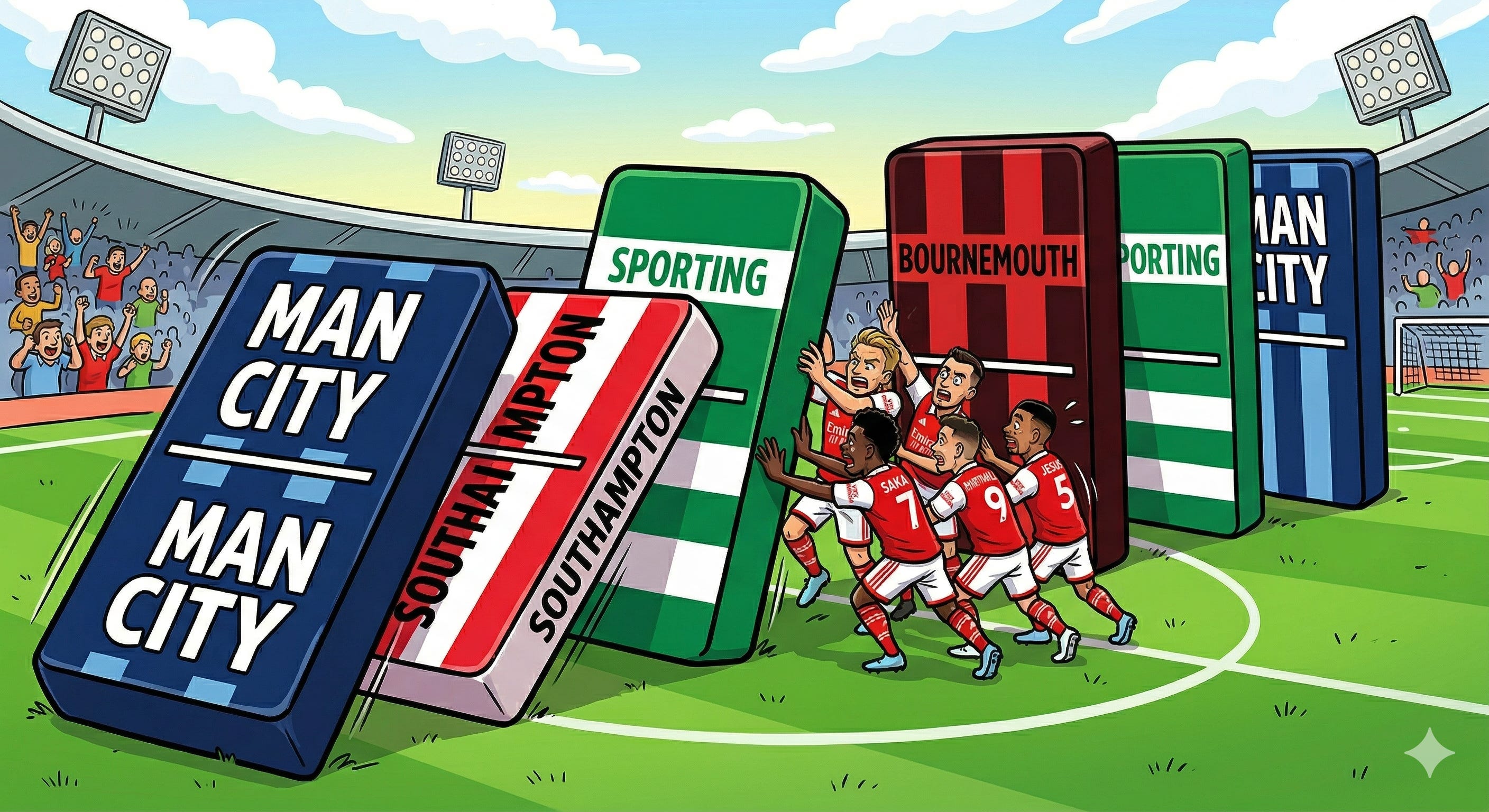
A loss against Sporting puts the Bournemouth result in jeopardy. Drop points there, and suddenly the CL quarters and the trip to the Etihad look daunting. If we lose at City and the gap shrinks to a point, they become the favourites for the league—the one trophy we actually have a proper shot at. It’s a domino effect waiting to happen, and we have to stop it in Lisbon.
The “pre-Carabao final” Arsenal would have gone to Lisbon, played it safe, kept it tight, and ground out a 1-1 draw to finish the job at home. But this rattled version? I’ve no idea which side will show up. The variance is massive right now.
Predicting the XI is guesswork with the current injuries. But whoever starts on Tuesday has the quality, the needs skills and the coaching to get a result. If Arteta can galvanise them, make them believe in themselves, make them believe they’re writing history this season, they’ll be fine. But is Arteta in a proper mental state to galvanise himself?