
Summer break. Just looking around
With all the 48-team World Cup action, it’s suddenly dawned on me that we’re barely a month away from Arsenal returning to Premier League action. And the Community Shield is even a week sooner!

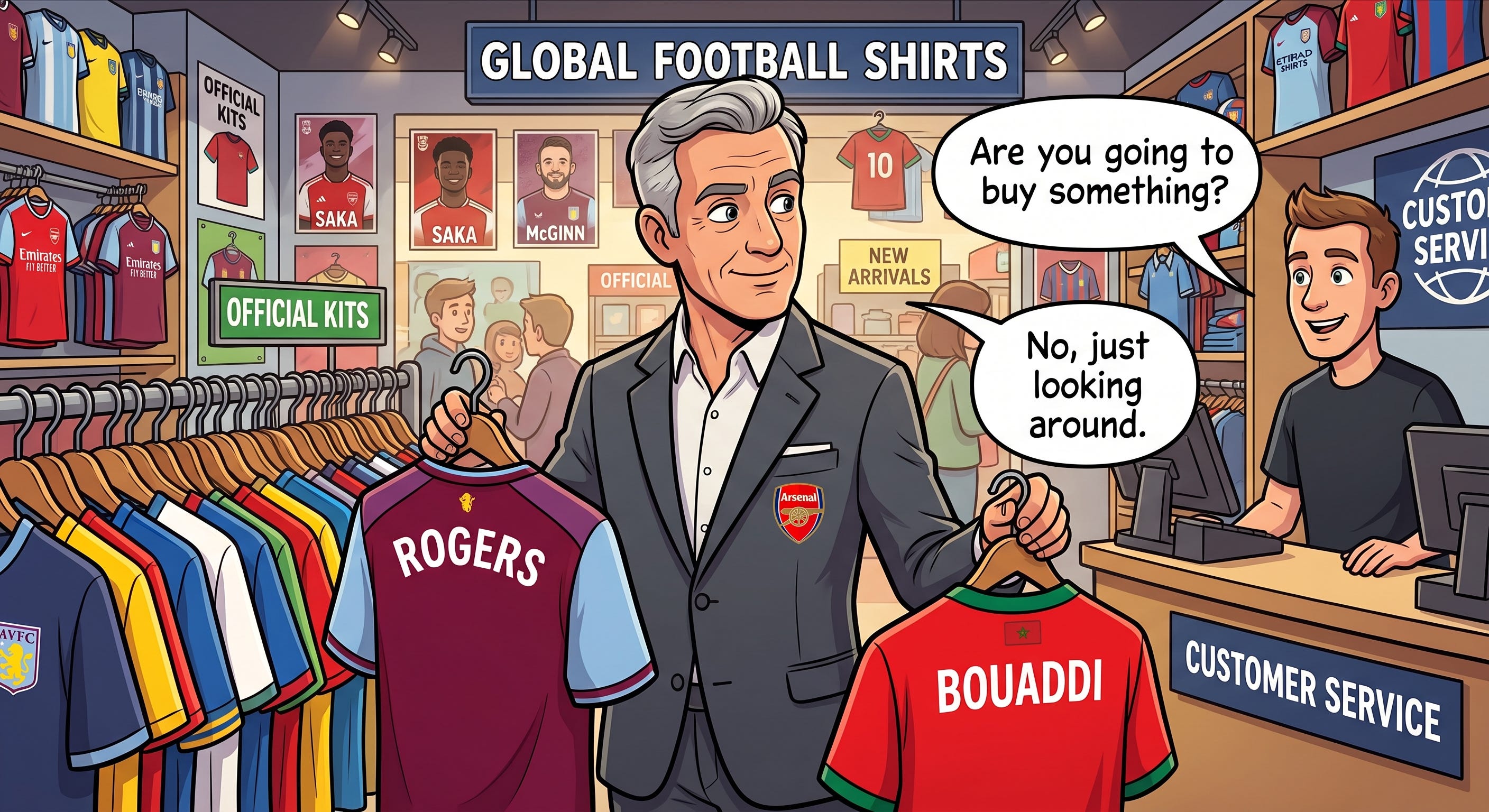
So, let’s quickly digest the World Cup news. Most of the games, despite being entertaining enough, didn’t produce too many real shocks. Germany and Brazil looked well off the pace in the group stage, so it was only a matter of time before they went crashing out. Therefore, I want to focus on the semi-finals, which really could have gone either way.
England against Argentina was by far the more intriguing of the two ties. Most people I spoke to (spanning over ten different European and Asian countries) wanted Argentina to lose, and only one—a proper Messi fanboy—was rooting for them. I reckon there are two main reasons for that split.
First up, it became glaringly obvious that FIFA were desperate to get Argentina into the final. It wasn’t down to outright scandalous refereeing, but rather every single borderline call going their way. VAR, which was supposed to eliminate human bias through technology, has been completely undermined. The humans at the wheel simply refused to yield to the system, taking back control by choosing exactly when to call for a review. Look, football is a contact sport; if you look at any phase of play in slow motion for long enough, you’ll find a foul. Just the referee being told to review or ignore an incident can completely steer the outcome of a match. Granted, if a team is completely outclassed, it won’t save them. But for a side that actually creates chances, it’s a massive helping hand. The motive for wanting Argentina in the final is crystal clear—Messi is a colossal superstar in the States, and casual fans will only tune in if there’s a household name to pull for. Argentina in the final guaranteed astronomical ratings and, by extension, heaps of cash for a greedy FIFA machine. (And seriously, can anyone explain why Infantino has to be plastered across our screens at every single bloody game?)
Secondly, Argentina’s racist reputation precedes them, and frankly, their squad behaves more like a criminal syndicate than a football team—well-known goalkeeper included. They don’t just stick to ‘smart fouls’; they are openly brutal and completely disrespectful, and the most infuriating part is that officials let them get away with it time and again. The double standards were on full display in the Argentina-Switzerland game. After their extra-time goal, the entire squad and the ref spent a good five seconds waiting around while Messi casually strolled through the centre circle. In the Premier League or the Champions League, that kind of blatant disrespect gets you an instant booking, but Messi and co seem to operate under a different set of rules.
In my book, England were easily one of the two big favourites to lift the trophy, mostly because I rated Thomas Tuchel incredibly highly when it comes to one-off knockout football. He might be a nightmare to manage over a long season, but he’s usually brilliant at adapting to specific opponents. This match, however, saw his stock plummet in my eyes. England had a decent first half, got the goal early in the second, and Argentina weren’t creating much—everything was going strictly to plan. A lot will be written about the substitutions, so let me add my two cents as well :) The first tactical tweak, switching to a 5-4-1, actually made sense on paper. Argentina love to funnel attacks through the middle, so packing the central areas while sacrificing the flanks looked like a sensible way to extinguish any impending fires.
But on the other side of the pitch was one of the greatest players to lace a pair of boots, a man who has achieved a lot, due to also his supreme reading of the game. Naturally, Messi started drifting out wide, dragging English shirts with him and opening up gaping pockets of space through the middle. This was already evident before that hydration break Pickford was begging for, yet somehow Tuchel completely missed the fact that the English backline was buckling under the pressure. Instead of addressing it, he doubled down on defensive subs. England were already struggling to retain possession, but hooking Rice to bring on two more defenders made it a proper ‘mission impossible’. The gamble was that simply parking the bus would see them over the line.
I’ve often slaughtered Mikel Arteta for employing similar negative tactics with Arsenal, but Tuchel’s England took it to a whole new level of frustration. At least Arsenal boast a cohesive defensive unit who have played together for years and know exactly how to maintain a compact shape. Tuchel threw together Stones, Konsa, Guehi, and Spence—names that hardly inspire confidence when it comes to an organized rearguard.
Inviting an opponent onto you by parking the bus right on the edge of your own 18-yard box only fuels their confidence, especially if they’re carving out half-chances. At this elite level, just about any attacking player has the technical quality to skip past a couple of defenders and smash one into the top bins if they’re riding a wave of adrenaline. I’ve heard the excuse that the players were naturally dropping deeper because they couldn’t keep the ball, so the subs were just reacting to the game. But what about the psychological blow to your own attackers when they see a double defensive change being prepared on the touchline? How are they supposed to believe they can go and grab a vital second goal, which felt absolutely essential given how heavily Argentina were knocking on the door?
The tactics were completely baffling, particularly as England aren’t exactly blessed with world-class defenders but possess a wide selection of different attacking talent. First and foremost, Tuchel should have had the balls to drop Harry Kane, who was a complete passenger. Kane simply lacked the legs to run up-and-down the pitch — which is fair enough given his age and the stage of the tournament. Tuchel made that brave call against Mexico, but when the pressure was on this Wednesday, he bottled it.
In his arsenal (pun fully intended), Tuchel had Ollie Watkins, who alongside Morgan Rogers has forged a reputation as a lethal counter-attacking duo. He had Eberechi Eze, renowned for his directness and vertical threat with Palace. Even with Bukayo Saka clearly unfit—hence his total absence from the pitch (was he unfit though?)—Tuchel still had individual ball-carriers like Noni Madueke and Marcus Rashford at his disposal. Even if Madueke doesn’t always link up seamlessly with the rest, he can still beat his man and win crucial fouls high up the pitch to relieve the pressure. Instead, Tuchel sat on his hands until it was far too late, handing Argentina the keys to the match.
I don’t have the clue what convinced Tuchel that this current crop of England players could successfully park a bus. If he was relying on how it worked against Mexico, the gulf in class between the opponents was immense. Mexico simply ran out of ideas when confronted with a packed box because they rely so heavily on exploiting open space to transition.
Perhaps Tuchel was falsely inspired by the other semi-final, where Spain completely neutralised France. But as well as being far more tactically astute than England defensively, Spain possessed one critical weapon that won them the match. Every time France surrendered possession, Spain starved them of the ball, forcing Les Bleus into an organized press that they rarely managed to pull off. That is the ultimate way to deny space because it stops the opponent building any sort of rhythm, completely draining their momentum and belief. Some have compared that suffocating Spanish display to what we saw from Arsenal last season, but I’d argue the Spanish were far superior at keeping the ball under intense heat. Arsenal have never quite managed to strangle a top-tier opponent like Man City or Liverpool while dominating possession; that tactic was usually reserved for lesser sides. The biggest team we truly managed to suffocate was probably Inter Milan at San Siro.
To wrap up, I’ll be firmly in the Spain camp come Sunday evening, and I’m desperately hoping our boy Mikel Merino can bag a third last-minute winner in these World Cup knockouts. The lad keeps showing us that he’s far more effective deployed as a second striker rather than the deeper midfielder Arteta originally envisioned. I can easily see him thriving in a front two alongside someone like Eze, Alvarez, or Rogers (who is that?), providing the physical presence and link-up play to unleash a more dynamic partner.
The massive dampener on that France-Spain semi-final was the news of a long-term injury to William Saliba. Frankly, injuries to these chronically overplayed Arsenal players were a car crash waiting to happen. Saliba, Rice, and Saka (why on earth are they starting a bloody third-place game?!), Gabriel, Zubimendi—they were all on the verge of breaking after a grueling club campaign. Aside from Gabriel (and Zubimendi, who barely featured, so doesn’t really count), all of them have reported issues and SHOULD miss the opening weeks of the season. Saliba will likely face a much longer spell on the sidelines, and he is without question our most indispensable defender. He’s the quickest, coolest under pressure alongside Timber, and superb on the ball. Losing him for an extended period severely damages our silverware hopes.
To be perfectly fair, this is entirely on Arteta and his stubborn habit of playing his key men until they literally cannot walk. We’ve hit the business end of the season with an exhausted, injury-ravaged squad two Aprils on the spin now, and it’s no fluke. Arteta openly declared that ‘top players should be able to manage 70 games a season, fatigue is just a state of mind,’ essentially writing off rotation as a weakness. When you hammer that macho mentality into your players, expecting them to play through the pain barrier for the badge, of course they’re going to carry that same attitude into international duty. If you tell them they should be playing 70 games a year, why shouldn’t 10 of those be for England? You can’t just flip a switch and turn that mentality off, and it’s taking a massive toll on their bodies.
We got further proof of Arteta’s uncompromising stance via a leaked story claiming Eze actually begged Arteta to ease off the training intensity in April to let the players manage the title run-in themselves. I doubt Arteta was best pleased to see that hit the back pages, but my theory is that a concerned club employee leaked it intentionally to sound the alarm bells for the owners.
Arteta then demanded an internal review into the ‘injury crisis’, which was rather conveniently carried out by his own mate and resulted in the sacking of medical staff Arteta hadn’t personally appointed. Alarming stuff, isn’t it? You’d think a proper, effective review would involve an independent party, given the manager plays the biggest role in deciding exactly how many minutes everyone clocks. Instead, the doctors were shown the way out, while someone like Gabriel Heinze—infamous for his brutal mental approach to training, including denying players water—remained untouched.
The sheer hypocrisy of Arteta and Heinze on this matter is laughable when you realise neither of them ever played anywhere near that amount of football themselves—yet they claim to know what the modern player can handle. Both clocked under 3,600 minutes in their most intensive seasons, whereas last term alone, five Arsenal players racked up over 4,000 minutes only for the club.


The only saving grace that allowed us to navigate last season despite the injuries was our summer transfer business, giving us a genuinely deep squad to rotate. That, quite frankly, is about the only thing I’ve liked about Berta so far. His ‘plate-spinning strategy’ has hardly borne fruit otherwise. He hasn’t unearthed any proper bargains in the market, failed to convince any world-class talent to choose us over our actual rivals (and no, Spurs don’t count), and we still can’t sell players for a decent fee.
We’re well into the second half of July now, and while we’ve been linked with a whole host of names and told we need to raise funds, the window has been incredibly underwhelming so far. Our first piece of business is Illan Meslier on a free from Leeds. Like most keepers we track (Raya aside), he’s brilliant with his feet and possesses cracking reflexes, but he’s always got a massive clanger in him every other game. That’s simply not the profile of a keeper for a club aiming for the biggest honours; he’s basically a deflated Kepa. I don’t know if Kepa is off (rumour has it he is), but I can’t see a scenario where a 26-year-old with Premier League experience signs on just to sit on the bench unless an injury hits, especially since domestic cups are usually the backup’s domain. It feels thoroughly uninspiring, unless it’s just a stop-gap while Tommy Setford goes out on loan to develop.
Alongside Meslier, we’ve basically had confirmation of the Christos Tzolis for Leandro Trossard swap. Trossard has been an absolute revelation for the Arsenal faithful. Arriving as a mere squad option on the left flank, he went on to register a brilliant return of goals and assists in each of his three seasons in North London. Recording 19, 20, and 19 G/A—he was our model of consistency. Leo’s greatest trait was his sheer grit; he never shied away from an opponent and regularly dragged us out of a hole when the chips were down. Off the top of my head, I can instantly picture his Champions League equalizer against Porto, nutmegging Alisson for the third against Liverpool, the late equalizer at Stamford Bridge, his strike against City in the Community Shield, the beautiful goal against Sunderland last term, that absolute rocket past a helpless Emi Martínez at Villa Park, and, of course... that title-clinching goal at West Ham.
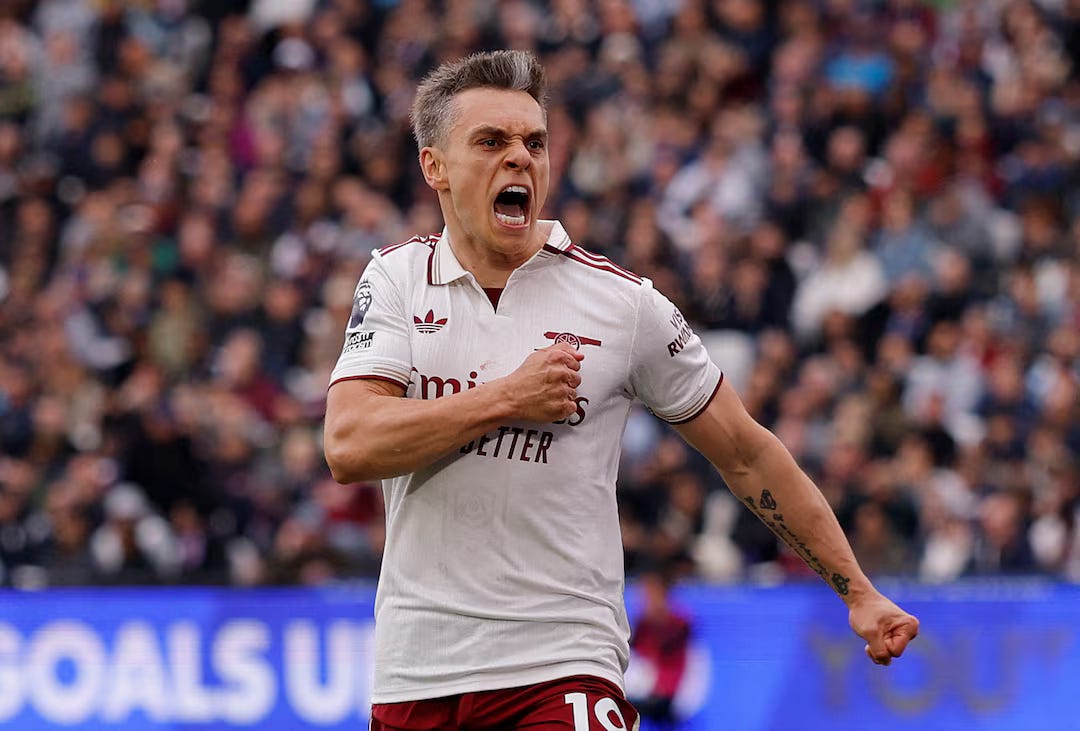
You truly deserved that Premier League medal, Leo! You have been a true revelation for the Arsenal fans. Your contribution will not be forgotten! We’ll be forever grateful for the memories, Mr. Clutch.
In case you missed it and haven’t already shed a tear.
On one hand, Trossard’s physical levels were dropping, often fading past the hour mark, so recouping some cash at his age makes business sense. On the other hand, you simply cannot replace that level of output for a measly £20 million.
Trossard proved an incredibly astute bit of business, but he was never a flashy, ‘sexy’ signing. Just like Christos Tzolis. A 24-year-old arriving from Club Brugge who doesn’t possess the immediate allure of a Riccardo Calafiori is hardly going to have fans sprinting to the online club shop to get his name printed on the back of the new shirt. But in my eyes, this is exactly the profile of player we should be targeting. Yes, he’s a gamble, but any hyped youngster coming off a single good season now commands a £90m+ price tag with absolutely zero guarantees. How many starlets with a high ceiling have moved for over ninety million quid and actually justified the fee? Off the top of my head, only Jude Bellingham to Real Madrid springs to mind. The rest are either wildly inconsistent or take years to come good, much like Martin Ødegaard did.
If we want to progress this squad—which means injection of fresh attacking options and plugging the gaps exposed last term—we need to be making these unglamorous £40m signings. That applies to finding backup options at right-back or centre-half as well.
Tzolis is very much in the Trossard mould—a pure output player who has racked up over 30 goal contributions across the last three campaigns. That’s a serious return. Yes, the Belgian league carries a risk, but it’s a proven breeding ground; plenty of top players have made the jump successfully, including Igor Thiago to Brentford last season, not to mention Mr. Clutch himself. His underlying numbers look fantastic, as highlighted in scouting pieces by CannonStats and LeGrove.
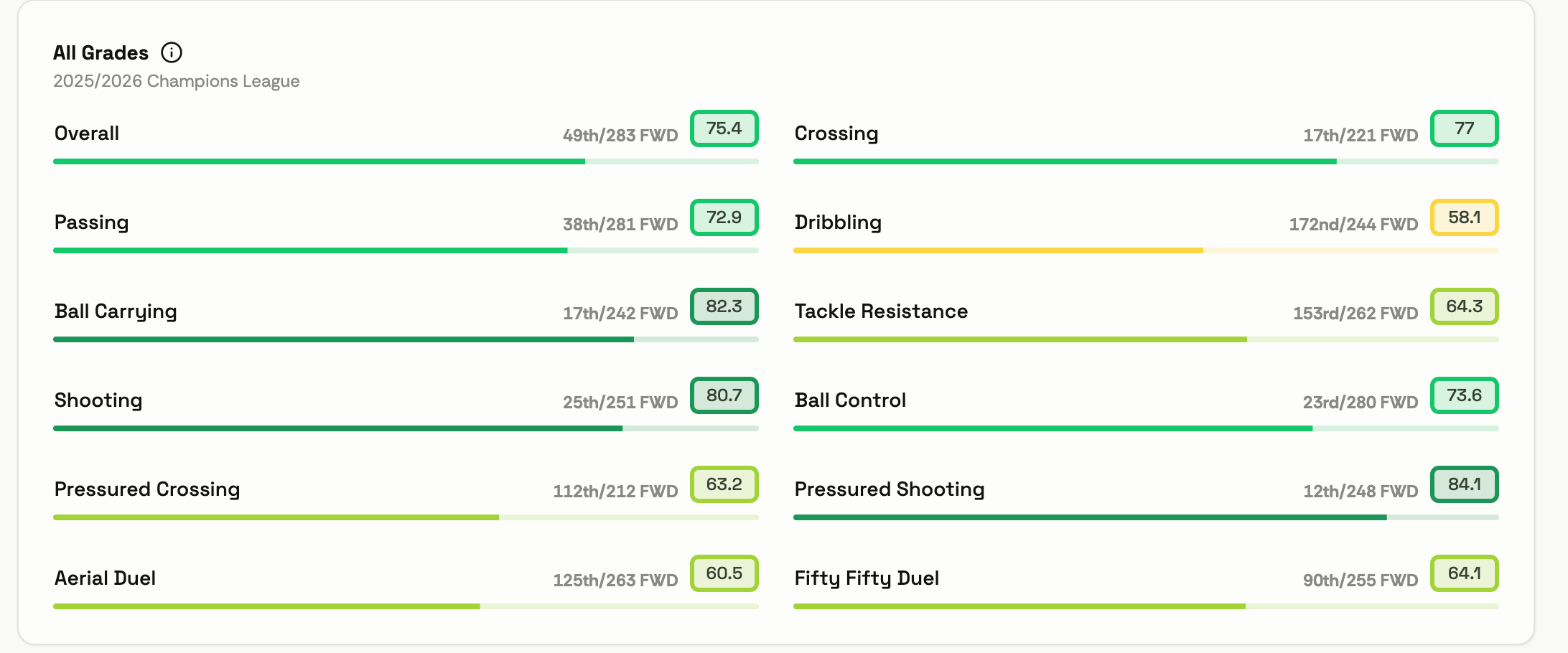
Essentially, he thrives at shooting under pressure, is a progressive ball-carrier, and doesn’t shirk his defensive shifts. All in all, a very smart, calculated gamble for a squad option upfront.
Let’s face it, we aren’t in a position to go out and buy more than one marquee £100m or £70m player, so these sensible, affordable acquisitions allow us to preserve the war chest for the positions where we desperately need an upgrade—namely a starting left winger or a central midfielder. We’ve seen a ridiculous number of names linked in the press: Fernández and Sandro Tonali (who both went to Spurs for a king’s ransom), Aymeric Bouaddi (courted by City for a cool £90m), Bradley Barcola, Alex Scott, and Julián Álvarez (who’s probably crying into a Barcelona shirt at night). Up until today, the two frontrunners were Bruno Guimarães and Morgan Rogers. And right as I was drafting this, Ornie dropped an absolute bombshell:
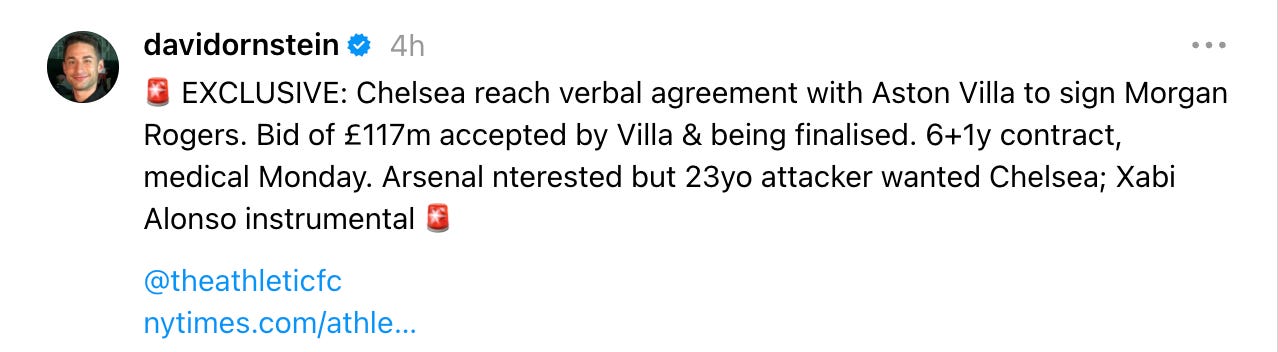
Off to Chelsea for £117m... On one hand, if we were looking at him to operate primarily as a left winger, £117m is an astronomical sum, especially since his finest attributes are unlocked when he’s playing closer to goal with space to run into—scenarios he rarely encounters on the flank in an Arsenal shirt. On the other hand, playing under Xabi Alonso means he’ll likely be utilized perfectly, which could well come back to haunt us. Reports that ‘Rogers preferred Chelsea’ came as a bit of a shock, but I wouldn’t rule out Alonso promising him a starting berth in his absolute best position. That said, if we are dropping that kind of cash, I’d rather we target an explosive, dynamic dribbler for the left—a profile this squad completely lacks.
Meanwhile, the Guimarães trail seems to have gone cold because Newcastle’s valuation simply doesn’t align with ours. While our sporting director was busy spinning plates, Newcastle managed to raise a massive amount of capital through the sales of Tonali and Anthony Gordon, putting them in a position where they can hold out for top dollar. I know Bruno’s profile doesn’t tick everyone’s boxes—at 29, you’re looking at maybe three top seasons with zero resale value. But for my money, he is the only candidate in the market who walks straight into our starting XI, immediately raises our ceiling, and solves a glaring issue.
We might just have to bite the bullet and pay up here, because we aren’t looking for a mere backup to Declan Rice. The most logical (and cheapest) option for that role would be Martin Zubimendi. What we actually need is a midfielder capable of progressing the ball under intense pressure, breaking lines, driving forward, and carrying a genuine goal threat from deep. We’re essentially looking for someone to compete with Myles, and bringing in an experienced 29-year-old ensures we have elite depth while giving the youngster the perfect environment to eventually inherit the role in a couple of years. A £100m asking price from Newcastle is steep, but £75m feels completely reasonable for a player of his calibre. Unlike Rogers, where the immediate impact was up for debate, there’s absolutely no doubt that Bruno makes us better overnight.
But as it stands, after all the endless plate-spinning, we’re left empty-handed with most of our primary targets already snapped up by rivals. If we dither any longer, we’ll probably see Barcola and Scott head off to Liverpool and United respectively, leaving us with a very expensive, desperate panic buy at the end of the window. I thought the whole point of having a well-connected sporting director was to get deals over the line swiftly, navigating complex negotiations with notoriously difficult agents. Yet here we are, with a solitary data-driven signing and having recouped just £20m for our clutch winger who created the most chances at the World Cup. Are you not entertained?
P.S. And just as I’m hitting publish, the ‘injury-risk’ Rice puts in a masterclass with a stunning goal and an assist, while ‘injury-risk’ Saka already bagged a brace in the first half against France. Surely they are also starting in the Community Shield now, aren’t they?