
Summer break. Smart and practical
Arsenal confirmed Christos Tzolis.. and that’s pretty much it.

Right then, we haven’t exactly set the world alight on the transfer front this week. Tzolis has been officially unveiled, but he was always North London bound according to the terms and conditions of the Ornstein bomb. Meanwhile, Morgan Rogers has indeed rocked up at Chelsea for a truly eye-watering fee. The only fresh twist is the realization that Alejandro Garnacho is heading in the opposite direction—the sort of accounting gymnastics that makes such an exorbitant price tag possible.
These club-to-club swap deals, involving inflated valuations for players, aren’t exactly a new phenomenon. We witnessed a similar carousel of exchanges a couple of years back between the likes of Chelsea, Villa, Newcastle, and Forest, right when Covid relief was wound down and the full weight of PSR returned to the fore.
The logic behind these “swaps” is pure spreadsheet wizardry: any sale is booked as immediate profit, whereas a purchase is amortized over the length of the contract (a loophole Chelsea exploited to the nth degree before it was capped at five years). So, if two players worth £20m are traded at £50m apiece, the club registers £40m in revenue for the current year, kicking the financial can down the road.
I’m not sure the Premier League can actually do much to pull the plug on this. You can’t stop teams trading players, nor can you forbid them from overpaying. There’s no forensic way to distinguish a dodgy deal from an honest one. The only real deterrent would be for the Premier League to force the entire purchase price to be counted upfront for PSR purposes. It wouldn’t change the statutory accounts, but PSR could simply overlay its own rules. After all, it’s only about twenty rows of data that need adjusting before the report goes in. It would fly in the face of standard accounting, but it would kill the incentive to inflate prices overnight.
I wouldn’t even argue that this strategy is inherently bad for squad building. If you’re looking for depth, other PL clubs often have surplus talent, even if they aren’t using it. Currently, Arsenal don’t seem to have a “partner in crime” for these shady exchanges. On one hand, it means we’re missing out on some creative recruitment; on the other, it’s a refreshing sign that our owners aren’t interested in mortgaging the future. It suggests they actually give a toss about the club’s long-term health, which can only be a good thing.
As an aside, I still haven’t a clue what Chelsea’s ownership is playing at. Hoarding youngsters, giving them minutes, and flipping them for a profit—as they did by offloading Andrey Santos to United—is a coherent, if cynical, model. But that logic evaporates when you splash a British record fee on a single player. Furthermore, they’ve just dropped another €100m on two more players, and the usual transfer gurus suggest they’re closing in on Lacroix and Alex Scott. Even with the exchange tricks, where is the cash coming from? Tainted FIFA money from the Club World Cup plays a part, but their sales are the real story. They somehow clawed back €339 million! last season from fifteen players, with the top of their donor list being none other than our club.
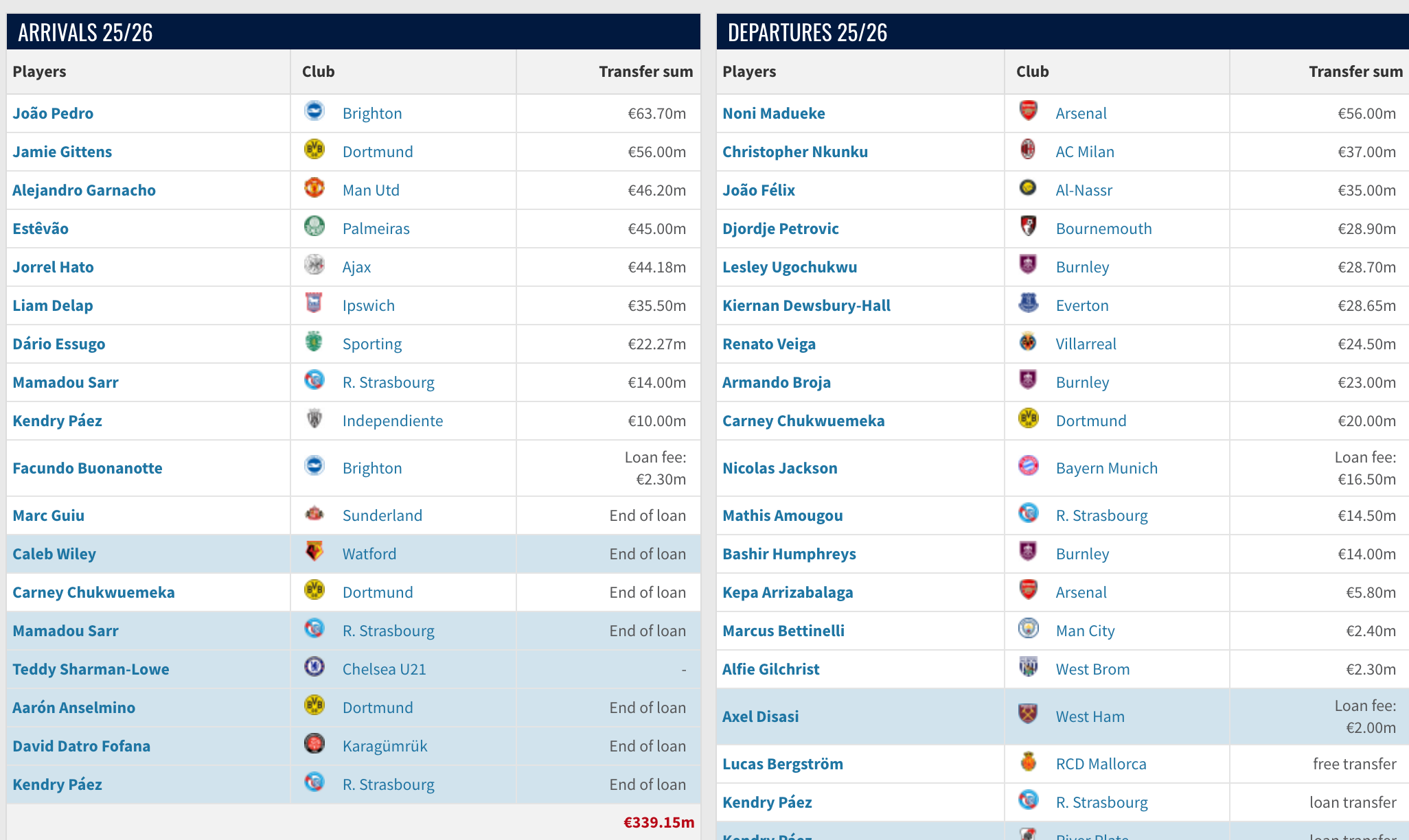
We, meanwhile, managed a measly €13.8m in that same window. Berta has done nothing so far to stop us from being the laughing stock of the market when it comes to outgoings. Given we even pushed the Hincapie fee into this calendar year, it’s glaringly obvious we won’t be signing any “marquee” names until we shift some deadwood. To be fair, looking at the squad, we have six players vying for the No. 10 and right-wing roles: Saka, Madueke, Odegaard, Eze, Nwaneri, and Dowman. We also have three options at No. 9: Gyokeres, Havertz, and Merino (and that’s ignoring Jesus or Vieira, who are still hanging around). KSE and their consultants will surely ask if we need them all before we even think about buying. Arteta would probably sacrifice Nwaneri first, but for me, Madueke is the one who should be moved on.
One major asset who could actually command a significant fee is Gabriel Martinelli, who has been effectively put in the shop window. Initially, the discussed price of £45-50m seemed absurdly low for a winger of his quality (everybody who can score goals in Champions league now command up to 100m), but then I found out that he’s only got a year left on his deal. That knocks about 40% off his value instantly. We likely have an option to extend, but the club are probably holding fire until the end of the window to see if a tempting bid arrives first.
We’re in a bit of a bind with Martinelli. Keep him, and we probably don’t sign a new left-sided attacker, meaning another summer where the forward line remains stagnant. Sell him for a laughable fee, and it’s a poor look for the champions. We can only justify his exit if he commands a club-record fee.
It is baffling that there isn’t more concrete interest. Gabi would be a dream for any counter-attacking side; his defensive work rate is every manager’s delight. The only problem is that those teams aren’t usually the ones winning silverware, and Martinelli likely isn’t keen on leaving the favorites for the next Premier League title.
The only “nearly elite” side that truly fits Gabi’s profile is Atleti, but they only seem to have eyes for Gyokeres. Personally, I think he’d be a revelation at Aston Villa (who have Champions League football, remember)—he’d wipe the floor with Garnacho there. He’d also be perfect for none other than Newcastle, who have a gaping hole on the left since Anthony Gordon jumped ship.
Sending him North in a part-exchange for Bruno Guimarães could really grease the wheels. Progress on Bruno has been glacial, much like the rest of our business this summer. The one thing in our favor is that, unlike Tonali or Gordon, Bruno is 29. He’s not the kind of player these “exchange platform” clubs are looking for. He won’t want another “project” either; the big trophies are now or never for him. For Newcastle, this is the last chance to get a massive fee for him—I’d expect close to £80m. The only teams that suit him are those that set for contending for titles right now with a vacancy in midfield. That’s us... or perhaps Real Madrid, where patience is always in short supply.
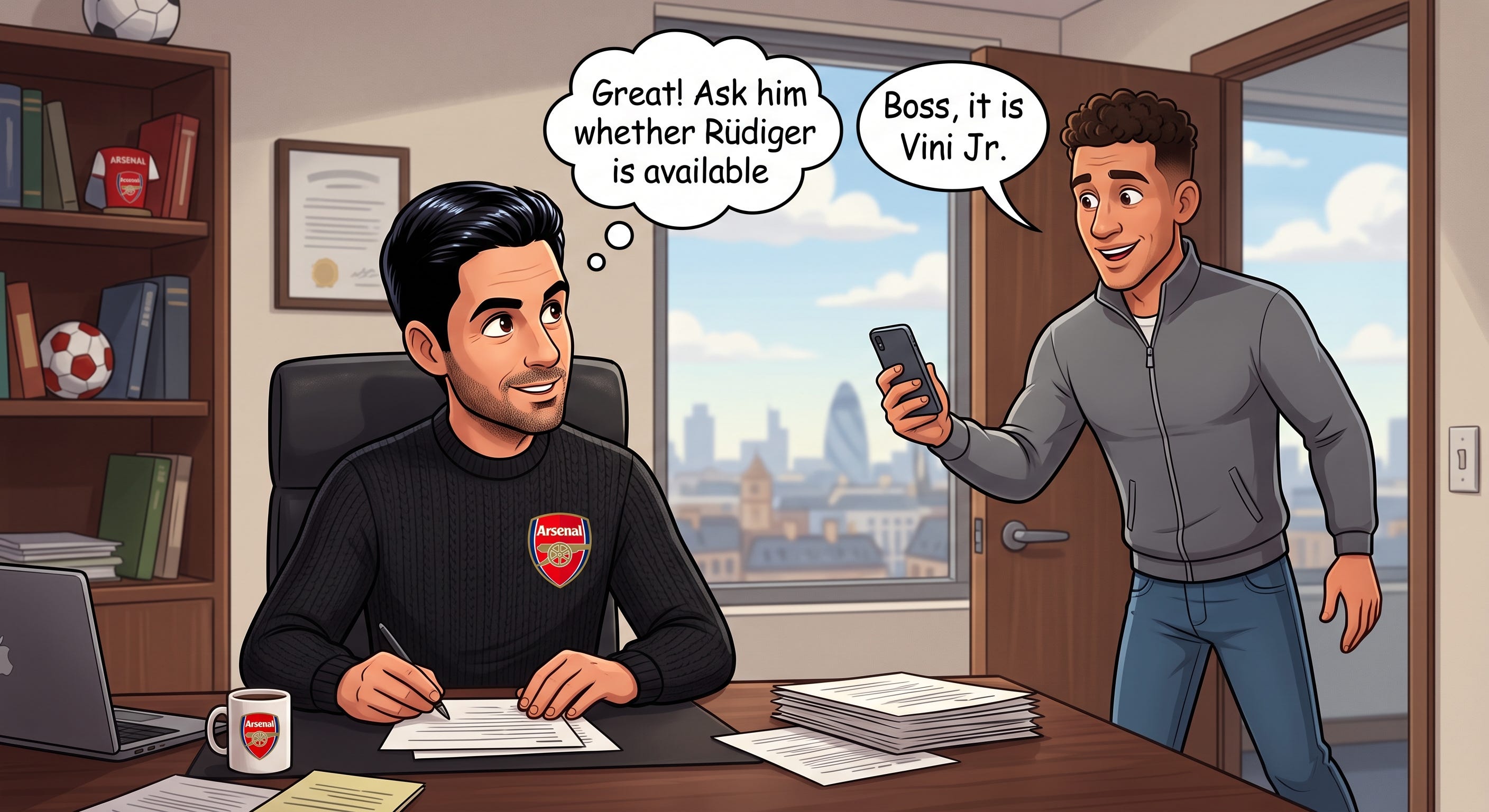
Ornstein dropped another “bomb” yesterday, though it felt more like a damp squib: Arsenal are apparently exploring a move for Real Madrid’s Vinícius Jr. If you read between the lines, there’s nothing to suggest this is remotely realistic. No contact with the club, no word from the player, no amounts, and no reason for Madrid to sell. My hunch? It’s a bit of PR fed to David to keep the fans from moaning about a quiet week in the market.
For South Americans, Real and Barça are the pinnacle; players don’t leave unless there’s a massive falling out. Madrid have reportedly offered him €20m a year, which would blow our wage structure to smithereens. Mourinho would also be a madman to let that kind of talent walk. Even if he were forced out, I’d put my money on him joining City—they already pay Haaland half a million a week and he wouldn’t be expected to track back Matty Cash and can even dictate some conditions.
Anyway, who needs Vinícius when you’ve got the Greek magician Christos Tzolis? The more I dig into the analytics, the more I’m convinced this is a smart, practical signing designed to replicate Leandro Trossard’s impact. Tzolis is pure output: he’s got a decent shot, finds his teammates in the box with ease, and is tidy in tight spaces. Plus, his set-piece delivery is top-notch, which is vital if Rice or Saka are unavailable. He lacks lightning pace, but in our slow, methodical build-up which allows opponents to set back into their shape, agility and composure under pressure matter more than raw speed.
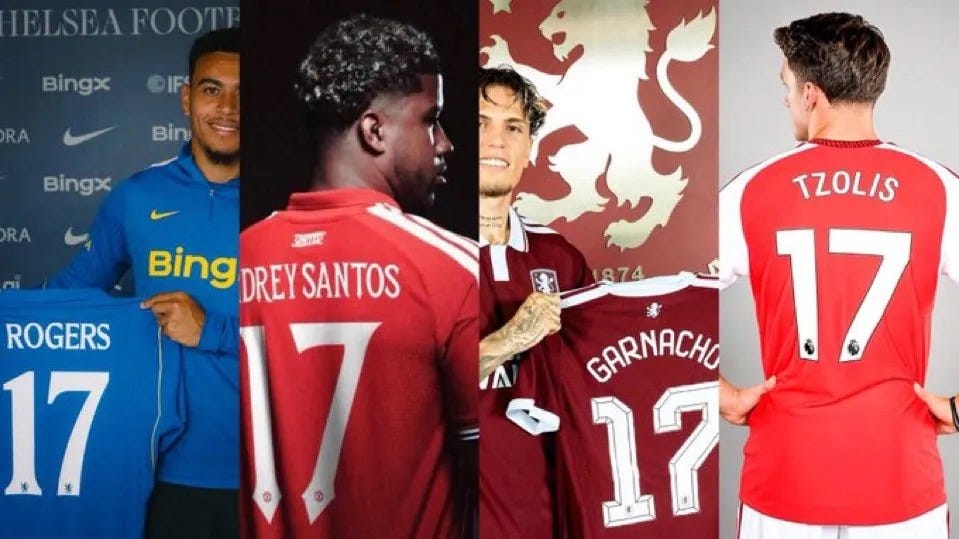
Beyond his technical traits, his record is superb—over 20 goals in the last three seasons. Whether he can translate those numbers to the Premier League is the big question, but you could say that about anyone coming from outside the big leagues. For a “low-hype” signing, he’s one of the smartest options we could get. He won’t be a one-man highlights reel, but I’d wager our new number 17 bags 20 G+A next season—more than Madueke and twice more than Madueke managed last term. It is interesting to see which number 17 of this four would end up with the largest numbers near his name next May.
What I also like about signing a 24-year old from a “smaller” league is that he knows how important of an opportunity it is, how hard he should work and that he should expect to sit on the bench and wait for his chance patiently. He knows that if it doesn’t work at Arsenal, he won’t get another chance to play in the top club. Probably similar to the “make it or die injure yourself trying” attitude Trossard had.
The strongest rumour doing the rounds post-Tzolis involves another defensive recruit to provide cover for Saliba, with Aston Villa’s Ezri Konsa touted as the preferred candidate. Now, this is where I start to get a bit twitchy. Konsa would likely set us back at least £40 million—if not more—given Villa are under no pressure to sell. Splashing that kind of cash on him suggests we’d only have room for one “big” signing in the final third, whether that’s a left winger, a second striker, or Bruno. And, let’s be honest, we’re crying out for both a progressive midfielder (doesn’t have to be Bruno; Scott or several others would do) and another goal-threat up top.
There are two ways this Saliba injury saga plays out. The first, rather grim scenario is that he’s sidelined until December or beyond, necessitating a long-term replacement. In that specific case, a move for Konsa makes a lick of sense. We haven’t heard anything quite so alarming from the club just yet, but they could well be playing their cards close to their chest to keep the asking price from skyrocketing.
The second scenario is that Saliba is back by mid-November. During that window, we’re only looking at ten Premier League outings and four Champions League nights, punctuated by two international breaks. If Arteta sanctions a massive fee just to plug a 14-game gap instead of properly reinforcing the attack, I’ll be losing my mind. We need to be smart and practical and splashing cash for Konsa ain’t that.
For starters, we’ve already brought in Christian Mosquera as Saliba’s understudy. If he isn’t getting a run while the main man is in the treatment room, what was the point? And if the argument is a lack of experience of playing there on the highest level, how on earth is he supposed to get it if not now?
I’ll admit, a Mosquera/Gabriel partnership might leave me feeling a tad uneasy under high pressure, but there are ways to manage it. Firstly, Mosquera could be paired with Calafiori, who’d act as a safe, stabilizing influence. Secondly, we have Timber and White, both of whom have experience at right centre-back under Arteta. They’re calm on the ball, and a stint in the middle might actually be kinder on their bodies as they manage their returns from major injuries. Mosquera even filled in at right-back late last season—including shifts at the Etihad and against PSG—so I’m not overly worried about his ability to perform. To top it all off, we’ve got Marli Salmon, who looked capable as a rotation option.
If Arteta is purely searching for composure and seniority, we’ve already got a candidate in the squad who fits the bill: Christian Nørgaard. We aren’t going to fetch a decent fee for him, and Arteta clearly doesn’t fancy him in the engine room. But he’s there, he’s a leader in the dressing room, he’s filled in at the back before, and he doesn’t cost an extra penny. In my eyes, the only defensive signing that makes sense would be a right-back, and only then if there are plans to move Benjamin White on sooner rather than later.
The narrative we’ve been fed is that Arteta turned conservative, prioritizing the defense to finally drag us over the line. The promise was that once we became Champions, he’d release the handbrake and make our attack more expansive and daring. Many have drawn parallels with World Cup winners Spain—smothering control at the back and low number of conceded goals. However, they have the ability to slice teams open when it matters, which was well demonstrated in the final. That clinical edge is still missing from this Arsenal side, and I’m desperately hoping for some signs of that tactical evolution in 2026/27. But maybe, just maybe, a “defense-first” philosophy is simply what helps Arteta sleep at night, and we’re destined for another season of non-exciting safety-first football?