
Reflection time. The control addict
A proper look back at our performance in that Carabao Cup final.

It’s been a week since we lost to Man City in one of our most rubbish performances of the season. The podcasters and bloggers are already telling everyone to move on because there are bigger fish to fry, but I’m not over it. From a psychological point of view, the players need to forget, but all these excuses about why the loss “doesn’t matter” or “shouldn’t be taken seriously” are just pure cope.
“Carabao Cup isn’t prestigious anyway”
Nonsense. Arteta went with the strongest XI he could (bar Kepa, where I think Arteta was bound by his own sign-on promise). He didn’t give a run to Norgaard or Myles, who actually got us to Wembley, and even Max Dowman stayed on the bench. Arteta and the lads desperately wanted that trophy, regardless of what people say about the League Cup.
“City is a really good team”
This City side couldn’t beat Forest or West Ham recently and deserved to be eliminated by Real Madrid after being taken apart. They aren’t some invincible force in attack, and their defence can be got at. The most gutting part of the final was losing belief the second that second goal went in (as most of Arsenal fans did).
“It’s just one defeat”
Hate to break it to you, but in cup football, one defeat is all it takes to get binned off. Even in two-legged ties, it’s usually one bad 90 minutes that ruins the whole thing (unless you get battered 2-8 over the course of two games in a rare event). You don’t get second chances in a Cup.
Every competition we’re taking part in, besides the Prem, is a knockout. If you want to be the best coach or player in the land or in Europe, you have to be able to turn a game around when the pressure is on.
Arteta absolutely froze in that single game. He didn’t react fast enough and the Cup slipped away. For a coach who talks about winning everything and is hyped as a “generational” talent—and paid like one too—being a deer in the headlights for 15 minutes isn’t good enough. If you come out for the second half at 0-0, wasting a third of the remaining time in indecision is criminal.
When you’re facing the likes of Thomas Tuchel, Luis Enrique, or Pep Guardiola (the opposing coaches in the time of our worst cup performances, where we actually looked clueless), you can’t just wait for things to fix themselves. These world-class managers have the tactical nous to change a game in minutes. You have to be reactive and show the team you’ve got a plan B when things go south.
Guardiola shared this in one of the early Amazon documentaries: “I have to look confident in front of my team. Even if I don’t know what to do, I have to sound like I know”. He was criticized heavily for “tinkering” in the Champions League, when he prepared unexpected plans for the opponent. I understood why - he wanted to overcome the psychological fear of Champions League by showing the players he has something special prepared for the opponent, to inspire confidence in them, to take away the thoughts of the mental pressure. And I sympathize with this approach. It didn’t work out with his team though, he overestimated his players, they were searching for a reason to justify their insufficient performance levels.
Arteta’s profile
The gaffer’s calling card is quite clearly this obsession with total control. It’s why he’s got specialist coaches for every minor detail, from set pieces to throw-ins. It’s why you see him on the touchline, micromanaging every blade of grass with those constant shouts. It’s also why Eze has been in the doghouse for a month; Arteta prefers “compliance players” who mostly follow the script to the letter, rather than the mavericks who have the ability to raise the roof.
Now, you might point at Guardiola and say he’s a control freak too, but the results speak for themselves. The big difference is that while Pep often plays like a gambler (which might be driven by his confidence), Arteta is fundamentally risk-averse. Pep gets a buzz from the tactical gamble, trying a new system, solution or player and waiting for it to pay off. Arteta, conversely, only feels truly settled when he’s sticking to the original plan, praying for what he expected to happen actually materialising.
Arteta simply isn’t comfortable rolling the dice unless his back is firmly against the wall. That’s why he’ll run Zubimendi and Timber into the ground—playing them over Norgaard or White until they’re blowing out of their backsides—because in his head, the “reliable” choice is always the one that supposedly reduces risk.
It’s the same reason an out-of-form Saka keeps starting over Madueke. Madueke is the riskier shout against City, but he’s got that higher ceiling to actually make something happen, as we saw with his direct running. Instead, Arteta plays it safe to protect the defensive shape. It’s also why Max Dowman—arguably our most exciting spark right now—didn’t even get a sniff in a Game! Not even ten minutes at the end to turn the Cup Final around? Not for Arteta. Dowman’s a kid, and “kid” equals “risk” in the manager’s book.
That caution is why Nwaneri and Myles have been starved of minutes in the League this term and never let on the pitch in a critical moment. Myles has the technical engine to bypass a four-man press—we saw him do it against PSG last year—and he’s much better equipped for that than Hincapie. But because his current form is a bit patchy, Arteta won’t touch him for fear of him being caught in possession in our own half.
I reckon Dowman only got a run against Everton because we were heading for a point loss and every other attacker was firing blanks. To not use that momentum and throw him on for ten minutes against Bayer or City seems like a massive oversight. That Everton cameo clearly took Arteta out of his comfort zone, and he wasn’t keen on repeating the experience.
This mindset led to several blunders on the day. Starting a clearly out-of-form Saka and a stale Trossard (who needs a rest to be effective) felt like a safety-first move based on past credit rather than current form. He’s also ran Zubimendi into the dirt, because he feels more control with him in the side. As well as Merino for that matter. Most likely because they remind him of a younger version of himself.
Zubimendi was a proper disappointment, to be fair. We know Rice covers the mileage, so you don’t expect him to be the tactical architect, but Zubimendi, who presented to us a Spanish conductor, was simply static. He didn’t adjust our build-up at all, even when it was clear Kepa was struggling to find a pass.
Look at the second half: we were clearly under the cosh from the whistle, yet Arteta didn’t blink for five minutes. Calafiori was right there on the bench—exactly the type of player to break the City press. Why wait until the hour mark? Get him on by the 50th minute with a set of instructions (even if they turn out to be wrong, they can still inspire the team), especially with Hincapie walking a tightrope on a yellow card.
But no, he stalled. He’d probably pencilled in his subs for the 60th minute in his pre-match or halftime notes and didn’t feel comfortable deviating from the script. By the time he acted, as we all know, the horse had already bolted.
We lost that final because of psychological issues - collective fear of a high-stakes game. The lads couldn’t string two passes together, couldn’t live with City’s intensity, and looked clueless against their press. Aside from a few bursts from Madueke, our wingers didn’t lay a finger on their full-backs, who are definitely not best-in-class.
The “Arteta is a fast learner” narrative doesn’t wash with me if he can’t react in real-time during a match. You don’t win silverware if you have to wait for a post-mortem to figure out a counter-strategy. You need to fix it while the game is still live.
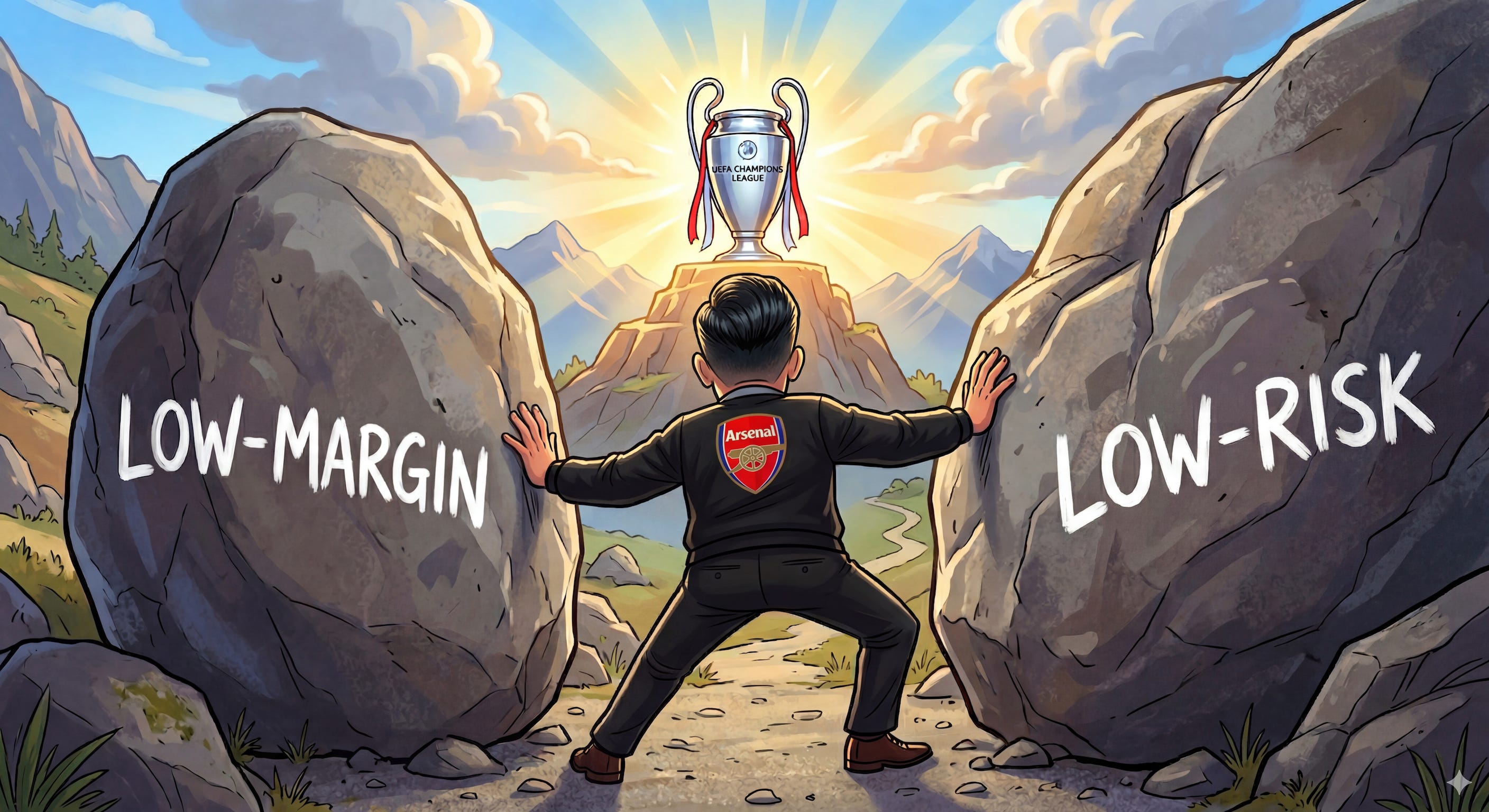
Arteta’s Arsenal side is a low-margin, effective out-of-possession, safety-first machine that doesn’t tend to take risks. On paper, that defensive solidity should be perfect for cups—you only need one chance if you can keep a clean sheet. But our mentality is the bottleneck. In a one-off final with low margins, the players with the gut to take a risk and convert an unlikely chance usually come out on top.
In the League, this “percentage football” usually pays off because things average out over 38 games. However, low-margin football can often end up in a draw and draws are the enemy of a title charge. Two safe draws earn you fewer points than a loss and a win. In the League you can be better than each single team - with a home win and an away draw. But taking only 4 points against each of the 19 teams means 76 points in total that rarely brings you to a League title. We’re sitting on 71 points with seven to go, but you can’t draw your way to the trophy—you have to go out and win games by scoring goals.
Arteta’s style of football is built to get high average performance and results, but it’s not making us favorites for the winner, the best team of the tournament. That’s why it’s been over five years since we lifted a proper trophy. On current form, we’d be massive underdogs for the Champions League trophy. Also not the favorites for the FA Cup (unless someone does us a favour and knocks City out 😀).
It’s unlikely that Arteta will change his routine now, so we’re left hoping he’s perfectly prepared for every scenario. I also have some rays of hope that a bit of individual magic from Eze, Rice, or Max Dowman saves our skin. It’s a really long shot, though.
Our best bet is the League, where we made ourselves favorites over the course of the season. We’re top of the pile and we need to act like it. Four or five wins and that trophy is ours! One thing I would hate to see is a points deduction for City before the season ends. I want us to win this fair and square for the sake of the team’s confidence and mentality growth. Let the authorities hit them in the summer and give their Champions League spot to Villa. They’ve waited years to settle the charges; they can wait another couple of weeks!
Great post.
Like I've always insisted, Arteta needs to leave at the end of the season especially if we end up potless. Or our players will start to have doubts and start to leave for glory elsewhere
I can’t say this is fair and balanced reporting. Eze is hardly in the doghouse and Dowman was brought on to ‘win us the game’ against Everton. Surely a more charitable explanation (and one which most balanced commentators have come to) is that there was no point in bringing Max on in a game that was lost (they scored twice in quick succession remember). I’ve kind of indulged your content for balance but I’m now thinking it’s too unbalanced for my likings so I’m out of here.